Last Updated: November 12, 2026
Quick Summary
Coffee can support gut health when you adjust how you brew and drink it, since the effect depends on your own stomach. Black coffee is often easiest on a sensitive stomach, and cold brew tends to be smoother than hot brew. Track how your body responds over two to three weeks before deciding a change is working.
- Black coffee has no added milk, cream, or sugar, making it easier on sensitive stomachs.
- Cold brew steeps in cool water for many hours and tends to taste smoother.
- Use 20 grams of coffee with 320 grams of water for a 1:16 ratio.
- Brew between 195 and 200°F, and avoid water just off the boil.
- Give each brewing change three to four days before judging its effect.
Table of Contents
- Does Coffee Help or Hurt Your Gut?
- Is Black Coffee Good for Gut Health?
- Is Milk Coffee Good for Gut Health?
- Is Instant Coffee Good for Gut Health?
- Choosing Beans and Roast for a Gentler Cup
- Step-by-Step Gut-Conscious Brewing Recipe
- How to Stop Coffee From Causing Diarrhea or Bloating
- Start Your Gut-Friendly Brew With Smokin Java Organic Roasts
- Frequently Asked Questions
Does Coffee Help or Hurt Your Gut?
Coffee does not hurt everyone's gut, and it does not help everyone's gut either. The answer depends on how you brew it, how much you drink, and how your stomach reacts. Many people drink coffee every morning and feel fine. Others feel bloated or rushed to the bathroom within an hour. Smokin Java has put together this guide to help you brew a cup that works with your body, not against it.
Coffee contains many compounds, including caffeine, acids, and plant chemicals called polyphenols. That is why one cup may feel gentle and the next may cause trouble.
What the research on gut microbiome diversity shows
Researchers are still learning how coffee interacts with the gut microbiome, the community of bacteria living in your digestive tract. Some studies link moderate coffee intake with a more varied microbiome, while others find little change. Results often depend on how much coffee people drank and what else they ate.
-
Early studies point to possible links between coffee and microbial diversity
-
Results vary from person to person
Evidence quality and its limits
Most of the research on coffee and gut health comes from small studies or observational work. Observational studies can show that two things happen together, but they cannot prove that coffee caused the change. Many studies also rely on people remembering what they ate and drank.
Watch out: Do not treat one study as proof. Track how your own stomach responds over two or three weeks before you decide whether a brewing change is helping.
Is Black Coffee Good for Gut Health?
Black coffee is often the easiest option for a sensitive stomach because it has no added milk, cream, or sugar. Plain coffee can still be acidic, though. The brewing method and the bean both shape how strong the acidity feels.
If you want to try a gentler cup, cold brew is a good place to start. You can explore our Cold Brew Coffee, which many people find smooth and easy to drink. For more on this topic, read How to Use Black Coffee During Intermittent Fasting.
Is Milk Coffee Good for Gut Health?
Milk can soften the feel of coffee in the stomach for some people. Dairy may also coat the stomach lining, which can make acidity feel less sharp. For others, dairy is the cause of bloating, especially if they are sensitive to lactose.
Try a small amount of milk first and watch how you feel. If you notice gas or cramps, switch to a plant-based milk or drink your coffee black.
Is Instant Coffee Good for Gut Health?
Instant coffee is usually more acidic than many brewed coffees, so it may bother a sensitive stomach more. It is convenient, but convenience can come at a cost to comfort. If you rely on instant coffee, try drinking it with food and keep the serving size modest.
Choosing Beans and Roast for a Gentler Cup
Bean choice matters more than many people expect. Lighter roasts tend to taste brighter and more acidic, while darker roasts often taste smoother. Roast level is only part of the story, though. Origin and processing also affect how the coffee tastes and feels.
If you want a gentler option, look for low-acid coffee and choose a roast that suits your taste. Our Is Light Roast Single Origin Good guide can help you decide whether a lighter roast fits your routine. You can also read about Reasons Organic Coffee Better Quality if you prefer organic beans.
Our Peru Decaf is a medium roast with tasting notes of caramel, smooth, and citrus, and it is decaffeinated using the Swiss Water Process. Our Mexico single origin is a medium roast with chocolate, cinnamon, and green apple notes.
Hot brew versus cold brew for stomach sensitivity
Cold brew is steeped in cool water for many hours. Hot brew is faster and gives a bolder flavor, so the right choice depends on what you value most.
- Cold brew: smoother in flavor, takes longer to make
- Hot brew: brighter flavor, ready in minutes
The table below sums up how the main brew options compare for a sensitive stomach, using only what the article describes.
| Option | Best for | Key difference |
|---|---|---|
| Cold brew | Smoother flavor | Steeped in cool water for many hours |
| Hot brew | Brighter flavor | Ready in minutes |
| Black coffee | Sensitive stomachs | No added milk, cream, or sugar |
| Milk coffee | Softer feel in stomach | Dairy may coat the stomach lining |
| Instant coffee | Convenience | Usually more acidic than brewed coffee |
Step-by-Step Gut-Conscious Brewing Recipe
The method below lets you adjust one thing at a time and see whether it changes the cup. It targets a smoother cup using a paper-filtered pour-over, which is an easy setup to control.
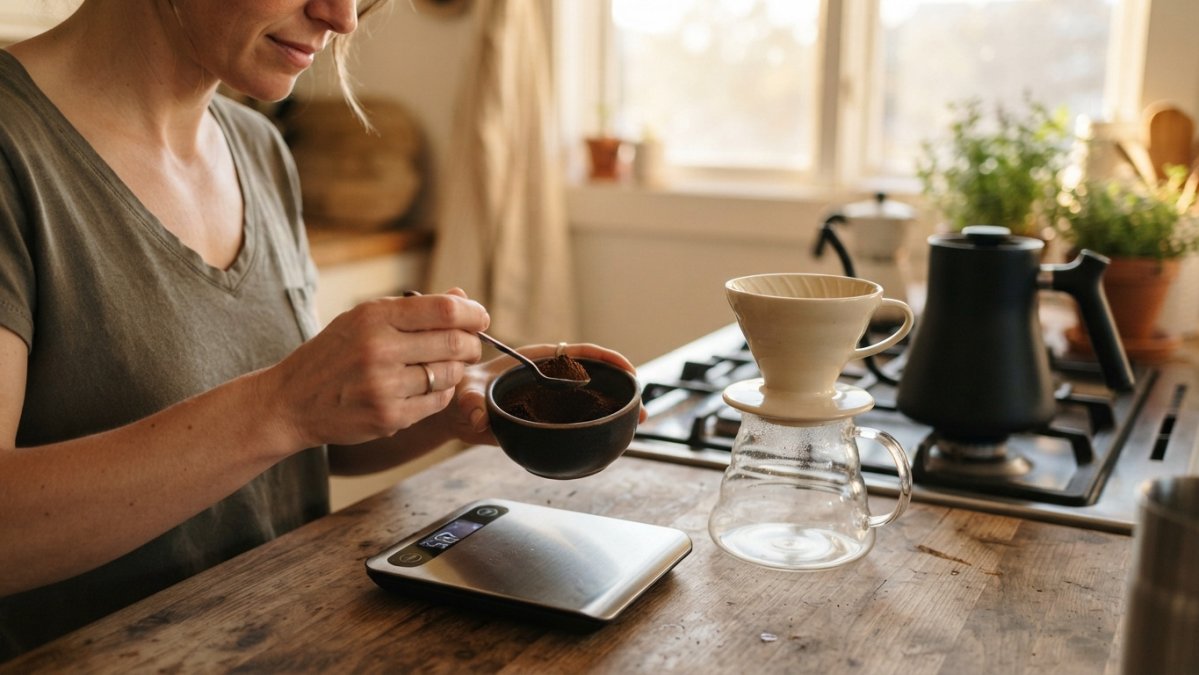
What you need: a burr grinder, a kitchen scale that reads in grams, a paper-filter pour-over dripper, a gooseneck kettle, filtered water, and a medium or dark roast.
- Start with the bean. Choose a medium or dark roast. Darker roasts tend to taste smoother than bright, light roasts.
- Weigh the coffee. Use 20 grams of coffee. Weighing beats scooping because scoop size varies wildly and throws off every other variable.
- Grind medium-coarse. Aim for a texture like coarse sand. A grind that is too fine slows the flow and can over-extract the coffee.
- Heat filtered water to 195-200°F. Water just off the boil extracts more harshly.
- Use a 1:16 ratio. That is 20 grams of coffee to 320 grams of water. A stronger ratio (1:12) concentrates acids and caffeine; a weaker one (1:18) tastes thin but is gentler.
- Bloom first. Pour about 40 grams of water over the grounds, wait 30-45 seconds, then continue. This releases trapped carbon dioxide so the rest of the water extracts evenly.
- Pour in stages over 3-4 minutes. Add the remaining water in two or three slow pours. Total brew time should land between three and four minutes.
- Use a paper filter. Paper traps more of the oily compounds and fine sediment that reach the cup in a metal filter or French press.
- Drink it within 30 minutes. Coffee that sits on a hot plate keeps extracting and turns more bitter. Skip sugar and heavy cream for the first test cup so you are judging the coffee, not the add-ins.
- Change one variable at a time. If the cup still bothers you, drop the water temperature by 5°F, then try a coarser grind, then a darker roast. Changing several things at once tells you nothing.
How this compares to other brewers. A French press uses a metal mesh that lets oils and sediment through, which gives a heavier-bodied cup. Espresso concentrates everything into a small volume. Cold brew steeps in cool water for 12-18 hours and is typically smoother in flavor. A paper-filtered pour-over gives you the most control over temperature and time.
Watch out: Do not judge a brewing change after one cup. Give each adjustment three to four days before deciding, because day-to-day digestion varies for reasons that have nothing to do with coffee.

How to Stop Coffee From Causing Diarrhea or Bloating
"Gut health" is not one outcome. Reflux, bloating, urgency, constipation, and general sensitivity have different causes and respond to different fixes. Match your symptom to the guidance below instead of applying every tip at once.
Reflux or heartburn
Start by cutting the serving size in half and trying cold brew or a darker roast.
Bloating and gas
Milk and cream are common culprits, especially for people who are sensitive to lactose. Try black coffee or a plant-based milk for two weeks.
Urgency and loose stools
Cut the serving size, drink it with a meal, and try a lower-caffeine option such as a half-caf or decaf. Check the serving size when you switch brew methods.
Constipation
Pair coffee with fiber and water rather than relying on it alone.
General sensitivity
If you cannot pin down a specific symptom, work through variables in order: serving size first, then dairy, then roast level, then brew method. Keep a simple two-week log with the brew method, the amount, the time of day, and any symptoms. Patterns usually surface within a week.
Watch out: If symptoms are severe, persistent, or include blood, unintended weight loss, or pain, see a doctor. Coffee is rarely the only factor, and self-tracking is not a substitute for medical evaluation.
A simple tracking protocol
Write down four things each day: the brew method, the amount in ounces, whether you drank it with food, and a one-to-five comfort score two hours later. After two weeks, compare the average score for each brew method. That gives you a real answer instead of a guess.
If you want a starting point, our Cold Brew Coffee is a smooth, medium blend built for cold brewing, and our Peru Decaf is a decaffeinated option.
Start Your Gut-Friendly Brew With Smokin Java Organic Roasts
Coffee enjoyment comes down to small choices: the bean, the roast, the brew method, and the amount you drink. Smokin Java roasts each batch to order and sources premium, organic beans from growers around the world. Our Cold Brew Coffee is a smooth, medium blend that works well for cold brew or nitro. Start with one cup a day, track how you feel, and build from there.
Smokin Java roasts each batch the day it ships, so your coffee arrives fresh and ready to brew. Find the blend that fits your stomach and your taste.
Frequently Asked Questions
Is black coffee good for gut health?
Black coffee contains no added sugar, milk or cream. If you are unsure how your body responds to it, try a smaller serving or a different brew method, and keep notes for two weeks before deciding.
How do I stop coffee from giving me diarrhea?
If you notice loose stools after coffee, start by reducing the serving size and drinking it with food. If loose stools continue after you change your routine, or if you notice blood, weight loss or persistent pain, talk with a doctor, because those symptoms need evaluation rather than a brewing fix.
Is instant coffee good for gut health?
Instant coffee is brewed and then dried, so its taste differs from a freshly ground brew. Whether it suits you depends on your preferences and how your body responds. Flavor-focused drinkers often find it less satisfying than a freshly roasted, freshly ground coffee.
Does milk coffee help or hurt digestion?
Milk adds fat and lactose to your coffee. If you drink milk coffee and want to test how your body responds, try black coffee for two weeks and compare the results.
