
Last Updated: October 27, 2026
Quick Summary
Compostable coffee packaging breaks down into organic matter under controlled conditions, trading durability and convenience for a lower-waste end of life. Its pros include strong brand fit with eco-minded buyers, while its cons include higher cost, moisture sensitivity, and dependence on local composting infrastructure.
- Compostable pouches need an oxygen barrier, moisture barrier, and one-way degassing valve to protect freshness.
- Empty compostable bags absorb ambient moisture, so store them cool and dry and rotate stock faster.
- Check whether your local organics program accepts compostable packaging before choosing it.
- A bag labeled commercially compostable may sit in a home pile for years without home-compost certification.
- Verify whole-package certification, since a film-only claim fails if the valve and zipper go to landfill.
Table of Contents
- Compostable Coffee Packaging Pros and Cons at a Glance
- The Case for Compostable Coffee Bags: Freshness, Waste, and Brand Fit
- The Drawbacks: Cost, Infrastructure, and Performance Limits
- Compostable vs Recyclable Coffee Packaging: Which End of Life Works Better
- Home Compostable Coffee Bags: What Actually Breaks Down in a Backyard Bin
- Compostable Packaging Certifications: How to Verify a Claim
- How to Dispose of Compostable Coffee Bags Step by Step
- Choosing Compostable Coffee Packaging for Your Roastery or Home Brew
- Frequently Asked Questions
Compostable Coffee Packaging Pros and Cons at a Glance
Compostable coffee packaging is a bag or pouch designed to break down into organic matter under controlled conditions, and its pros and cons come down to one tension: you trade durability and convenience for a lower-waste end of life. At Smokin Java, we ship fresh-roasted organic beans in eco-friendly packaging. Below, we break down what compostable bags do well, where they fall short, and how to choose without getting burned.
The short version: compostable bags have pros and cons. They need the right disposal conditions, and their performance can differ from foil.
Quick Comparison: Compostable vs. Conventional Bags
| Factor | Compostable Bags | Conventional Bags |
|---|---|---|
| End of life | Breaks down in composting | Sits in landfill for decades |
| Barrier strength | Good, but moisture-sensitive | Strong foil and plastic barrier |
| Cost per unit | Higher | Lower |
| Disposal effort | Needs sorting and a compost stream | Toss in trash |
| Shelf life | Shorter under humid conditions | Longer |
| Brand fit | Strong for eco-minded buyers | Neutral |
The Case for Compostable Coffee Bags: Freshness, Waste, and Brand Fit
Compostable packaging is one option for coffee bags, but its end-of-life outcome depends on the disposal route.
Freshness can hold up too. A well-built compostable pouch uses a multi-layer structure with an oxygen barrier, a moisture barrier, and a one-way degassing valve. To see how fresh roasting supports that same freshness goal, read about our Fresh Roasting Coffee Store. That valve lets roasted coffee release carbon dioxide without letting oxygen in. Get the layers right and your beans stay fresh through the roast date window.
There's a brand angle as well. Ethically-conscious buyers notice packaging.
Best for: roasters and home brewers who care about end of life and want packaging that matches their values.
The Drawbacks: Cost, Infrastructure, and Performance Limits
Here's where most guides get quiet. The drawbacks are real, and they cluster into three areas: what you pay, where the bag can actually go, and how the material behaves once it's holding roasted coffee.
Cost and operational trade-offs for roasters
- Storage and shelf life of the empty bags. Compostable film absorbs ambient moisture. Bags stored in a humid warehouse can lose seal integrity before they're ever filled, so inventory has to be kept cool and dry and rotated faster than conventional stock.
Infrastructure: the disposal reality
Infrastructure is the bigger problem, and it's local. Whether the bag is actually composted depends on questions your customers can't answer from the bag alone:
- Does the local waste hauler offer a food-scrap or organics collection program?
- Does that program accept compostable packaging, or only food waste?
- Is there a commercial composting facility in the region that takes the material?
Performance limits
Compostable films are more sensitive to moisture and heat than foil laminates. The mechanism is straightforward: the barrier layers in a compostable structure are typically thinner and more permeable to water vapor than aluminum foil, so in a humid kitchen the beans can lose aroma and stale faster once the bag is opened. The one-way degassing valve still handles carbon dioxide release, but it doesn't compensate for a weaker moisture barrier.
Compostable vs Recyclable Coffee Packaging: Which End of Life Works Better
Most guides frame this as a values question. It's really a systems question, and the honest answer depends on what happens to the package after the customer is done with it. Here's a decision framework that compares the two end-of-life paths on the factors that actually determine environmental outcome.
Side-by-side comparison
| Factor | Compostable packaging | Recyclable packaging |
|---|---|---|
| What it becomes | Organic matter (compost) | Recovered material for new products |
| Where it must go | Commercial composting facility, or a home bin if home-compost certified | Curbside or drop-off recycling stream that accepts the material |
| Common infrastructure barrier | Some organics programs may have restrictions on packaging | Curbside acceptance of soft plastic pouches can vary |
| Contamination risk | Non-compostable valve, zipper, or label ruins the batch | Food residue and multi-material laminates reduce recovery |
| Barrier performance | Good, but more moisture-sensitive | Strong foil and plastic barriers |
| End-of-life outcome if infrastructure is missing | Landfill | Landfill |
The recyclable caveat
Recyclable packaging keeps material in circulation, but only if it actually gets recycled. Acceptance of soft plastic coffee pouches in curbside bins can vary, and multi-material laminates may be difficult to separate. "Recyclable" on a coffee bag often means "technically recyclable somewhere," not "recyclable in your customer's bin." Acceptance of soft plastics can vary by region and material.
The compostable caveat
Compostable packaging closes the loop differently. It becomes soil, but only when it reaches a composting facility with the right temperature, moisture, oxygen, and microorganisms. Composting conditions and outcomes depend on the facility and the packaging.
A lifecycle view
Treating compostability as automatically better is a mistake. A lifecycle comparison depends on assumptions that are easy to hide:
-
Feedstock. Plant-based films may come from crops with their own land, water, and fertilizer footprint.
-
Manufacturing energy. Producing compostable film and producing conventional laminate use different energy mixes and yields.
-
End-of-life credit. Compost returns organic matter to soil; recycling displaces virgin material. Neither credit materializes if the package goes to landfill.
How to decide
Use this order of operations:
- Check the local stream first. Consider which disposal options are available in your area before choosing packaging.
- Verify whole-package certification. A film-only claim doesn't help if the valve and zipper go to landfill.
- Weigh performance. If shelf life and moisture protection are critical, a conventional high-barrier bag may outperform both options, and the honest move is to say so.
- Be transparent with customers. Tell them exactly how to dispose of the bag, and don't imply a benefit the local infrastructure can't deliver.
The appropriate end-of-life option depends on the packaging and the disposal options available locally. If you're weighing which brewing setup pairs with your coffee choices, our guide to pour over vs drip coffee is a good next read.
Home Compostable Coffee Bags: What Actually Breaks Down in a Backyard Bin
Home compostable coffee bags are designed to break down in a backyard bin at lower temperatures than commercial systems. That's a meaningful distinction. A bag labeled "commercially compostable" may sit in your home pile for years.
Check the certification to understand the composting conditions it covers.
Compostable Packaging Certifications: How to Verify a Claim
Certifications are how you tell a real claim from marketing. In the U.S., look for third-party compostability certifications tied to established standards, and check whether the certificate covers home or industrial composting. The Biodegradable Products Institute's compostable certification program is one of the bodies that verifies packaging claims.
If a supplier can't answer, treat the claim as unproven. The Federal Trade Commission's Green Guides set the rules for environmental marketing claims, and vague "eco-friendly" language without proof is exactly what they warn against.
How to Dispose of Compostable Coffee Bags Step by Step
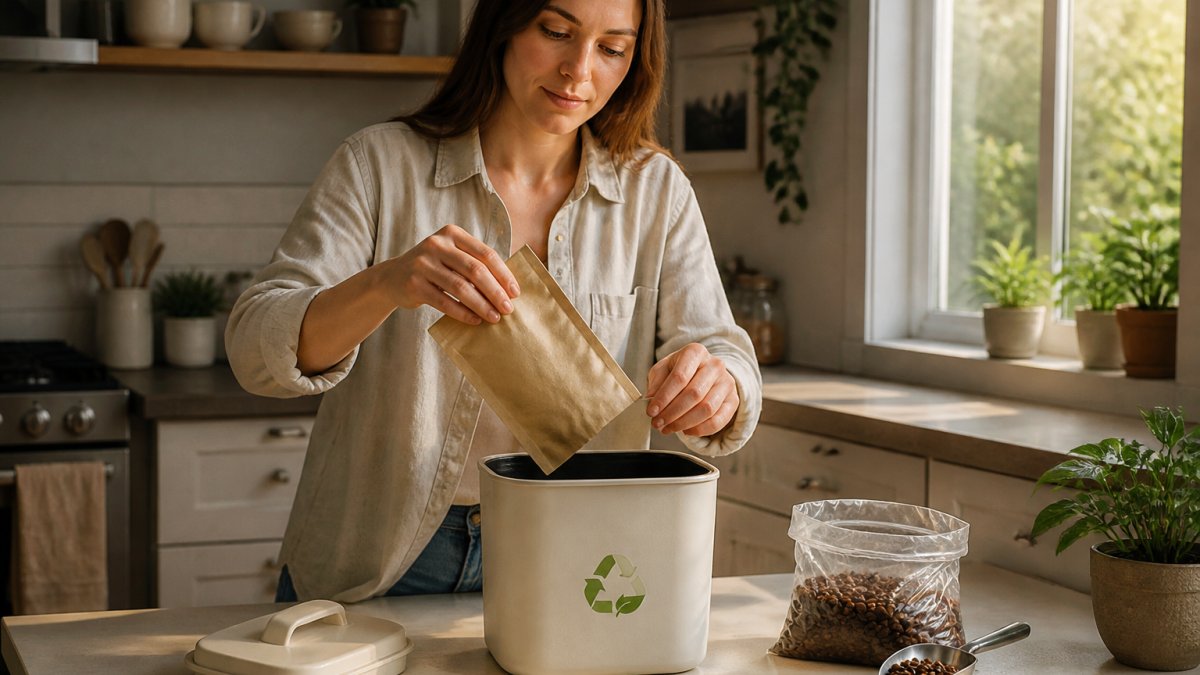
If you want to cut packaging waste further, a reusable capsule for Nespresso machines lets you skip single-serve pods entirely.
Choosing Compostable Coffee Packaging for Your Roastery or Home Brew
Choosing well comes down to considering the disposal options available to you.
If you want fresh organic coffee delivered to your door, you can explore our organic coffee subscription guide to see how fresh-roasted delivery works.
The 3-point checklist we'd use:
-
Confirm the certification covers home or industrial composting
-
Check that a composting stream exists near you
Frequently Asked Questions
Do compostable coffee bags need industrial composting?
Composting requirements depend on the bag's certification. Check the certification and your local program before deciding how to dispose of a bag.
Can compostable coffee bags go in curbside recycling?
Check the packaging instructions and your local recycling program for disposal guidance.
Are home compostable coffee bags as protective as standard bags?
Packaging performance depends on the specific bag. Ask the roaster about its packaging and any applicable certification.
What do compostable packaging certifications actually prove?
Check the certification details and your local program for information about composting and collection.
Compostable coffee packaging only pays off when the bag actually gets composted. That means matching the material to your disposal options, not just the label. At Smokin Java, we roast each batch the day it ships and pair organic beans with eco-friendly packaging, so freshness and responsibility travel together. Browse our single-origin roasts and signature blends, then add to cart and taste the difference fresh roasting makes.
