
Last Updated: October 26, 2026
Quick Summary
Pour over vs drip coffee differs mainly in control and attention: pour-over is manual brewing where you pour hot water by hand over grounds, while drip coffee is automatic and machine-regulated. Both methods produce similar flavor when variables like grind, water temperature, and ratio are matched, though pour-over typically yields a cleaner finish while drip creates a rounder body.
- Pour-over brewing takes 2.5 to 4 minutes total and requires a 30-45 second bloom phase where gases escape from the grounds
- Drip machines brew a full pot in 5-10 minutes and automatically maintain water temperature between 195-205°F without active participation
- The standard ratio for both methods is 1 part coffee to 16 parts water by weight, or one tablespoon of ground coffee per six ounces of water
- Pour-over suits single cups and small batches gracefully, while drip machines handle 5-12 cups more practically for households and entertaining
- Paper filters in either method produce a cleaner, lighter-bodied cup, while metal filters add more body and texture to the final brew
Table of Contents
- Pour Over vs Drip Coffee: The Core Differences
- How to Make Pour-Over Coffee at Home
- Drip Coffee Brewing: Automatic Simplicity
- Flavor and Extraction: What You'll Actually Taste
- Choosing the Best Pour-Over Coffee Maker
- Batch Size, Consistency, and Your Daily Routine
- Start Your Pour-Over or Drip Journey with Fresh Beans
- Frequently Asked Questions
Pour Over vs Drip Coffee: The Core Differences
When comparing pour over vs drip coffee, they aren't the same thing, though many use the terms interchangeably.
Pour-over coffee is manual brewing.
Drip coffee is automatic. You load grounds and water into a machine, press a button, and it handles the rest.
This distinction affects your workload, consistency, and flavor.
Manual brewing gives real-time feedback: you see the water color change, hear the pour, smell the bloom.
How to Make Pour-Over Coffee at Home
Pour-over brewing is straightforward once you know the steps and takes about three to four minutes.
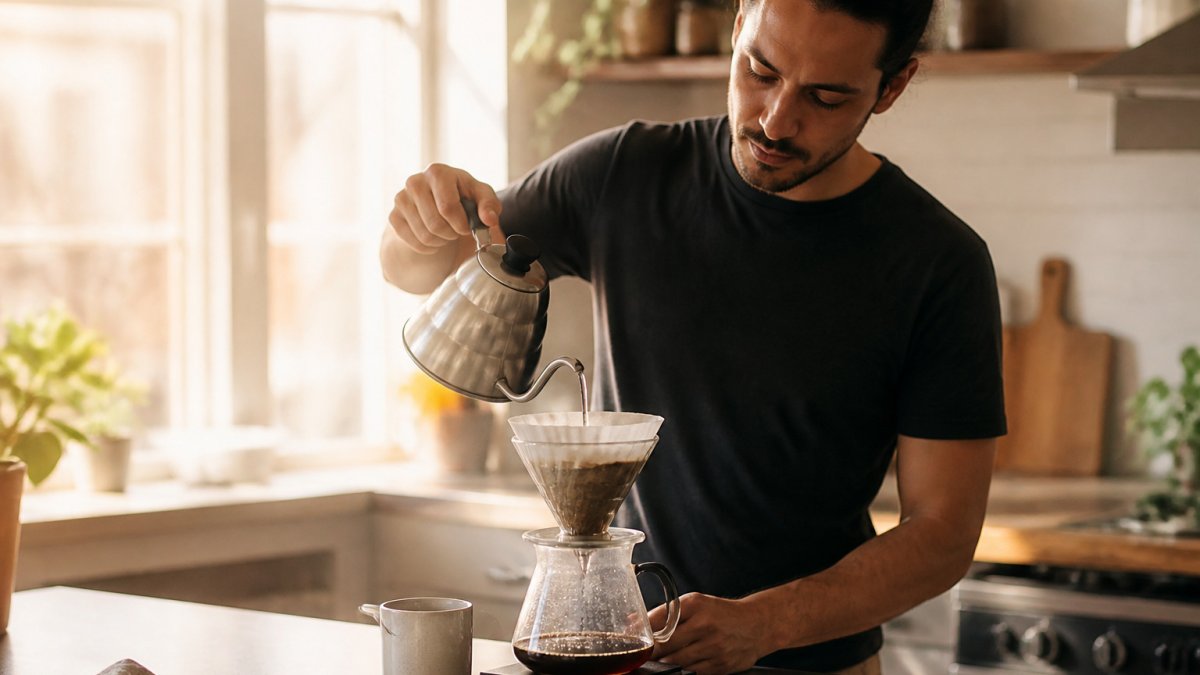
Here's what you need:
- A pour-over brewer (ceramic, glass, or plastic cone)
- Paper or metal filters
- Ground coffee
The basic process:
- Place your filter in the brewer and rinse it with hot water to remove paper taste and preheat the equipment
- Add ground coffee to the filter
- Pour a small amount of hot water (just enough to wet the grounds) and wait 30-45 seconds, this is called the bloom, and it allows gases to escape
- Slowly pour the remaining water in circular motions, keeping the water level consistent
- The total brew time should be between 2.5 and 4 minutes
- Once water stops dripping through, your coffee is ready
Pour slowly and steadily: rushing makes weak coffee, while pouring too slowly over-extracts and turns it bitter.
Pour-Over Coffee Ratio and Technique
The standard ratio for pour-over coffee is 1 part coffee to 16 parts water by weight.
Grind size matters: pour-over works best with medium-fine grounds, finer than drip but not as fine as espresso.
Pour in slow, controlled circles for even saturation; uneven pouring creates dry spots and over-saturated areas, both producing inconsistent flavor.
Water should be 195-205°F. Boiling water (212°F) scalds the grounds; cooler than 195°F won't extract enough flavor.
Pour-Over Coffee Brewing Time
Total brew time for pour-over coffee typically ranges from 2.5 to 4 minutes, including the bloom phase.
Breaking it down:
- Bloom phase: 30-45 seconds
- Main pour: 2-3 minutes
- Final drip-through: 15-30 seconds
Under 2.5 minutes means your grind is too coarse or your pour too fast; over 4 minutes means too fine or too slow. Adjust these variables to dial in flavor.
The bloom isn't optional: those 30-45 seconds let trapped carbon dioxide escape, improving extraction. Skip it and your coffee tastes flat.
Drip Coffee Brewing: Automatic Simplicity
Automatic drip machines handle all the variables for you. Load grounds, add water, press start, and walk away.
The machine controls:
- Water temperature (most maintain 195-205°F automatically)
- Water flow rate
- Brew time
That consistency is the drip machine's main advantage: every pot tastes roughly the same because the machine follows the same steps.
The trade-off is flexibility: you can't adjust pour speed mid-brew or stop early if flavor seems off.
Cleanup is simpler too. Remove the filter basket, toss the grounds and filter, rinse the carafe. No technique required.
Flavor and Extraction: What You'll Actually Taste
The flavor gap between pour-over and drip coffee is real but easy to exaggerate.
To compare fairly, brew both methods with the same coffee, the same dose, the same water, and the same ratio. Here is a matched recipe you can run side by side at home:
Matched comparison recipe (makes about 10 oz / 300 g brewed coffee):
- Coffee dose: 18 g
- Water: 300 g (ratio 1:16.7)
- Grind: medium-fine for pour-over; medium for drip (adjust drip one step coarser if your machine stalls)
Brew both cups back to back, let them cool to the same temperature, and taste blind if you can.
Why the flavors diverge:
- Filter type: Paper filters trap more oils and fine particles, which produces a cleaner, lighter-bodied cup. Metal filters and some drip baskets let more oils through, which adds body and texture.
- Water path: In pour-over, water passes through the bed once and exits. In many drip machines, the shower head distributes water unevenly and the bed can channel, which extracts some grounds more than others.
- Temperature stability: A pour-over cone loses heat during the brew unless you preheat it. A drip machine holds temperature more steadily. Temperature swings change which compounds extract first.
Troubleshooting by taste:
| Taste problem | Likely cause | Pour-over fix | Drip fix |
|---|---|---|---|
| Sour, sharp, thin | Under-extraction | Grind finer, slow the pour, raise water temp slightly | Grind finer, check that the machine reaches 195-205°F, brew a smaller batch |
| Bitter, harsh, dry | Over-extraction | Grind coarser, speed up the pour, lower water temp slightly | Grind coarser, reduce brew time by brewing a smaller batch, check for a clogged shower head |
| Weak but not sour | Too little coffee or too much water | Increase dose or tighten ratio | Increase dose or reduce water |
| Muddy, silty, heavy | Too many fines or metal filter | Switch to a paper filter, grind coarser | Use a paper filter if the basket allows, grind coarser |
| Inconsistent cup to cup | Uneven saturation or channeling | Pour in slower circles, ensure the bed is level | Level the bed before brewing, check the shower head for clogs |
Water quality affects both methods equally. Hard, chlorinated, or off-flavor water shows up in the cup regardless of method.
Grind size is critical for both: too coarse and water rushes through without extracting enough flavor; too fine and it over-extracts into bitterness.
For consistent results with fresh, high-quality beans, learn why freshly roasted coffee matters for brewing methods. The brewing method only works as well as your starting ingredient.
Choosing the Best Pour-Over Coffee Maker
Ceramic pour-over cones retain heat well and produce consistently good coffee, but can break if dropped.
Plastic pour-over cones are affordable and durable, though they retain heat less well than ceramic or glass.
Stainless steel mesh filters (if your brewer uses them) produce a heavier body than paper filters.
For consistent results with fresh, high-quality beans, learn why freshly roasted coffee matters for brewing methods.
Batch Size, Consistency, and Your Daily Routine
Batch size separates the two methods most clearly in daily use: pour-over scales down gracefully and up awkwardly, while drip machines scale up gracefully and down poorly.
Batch size guidance:
- 1 cup (8-12 oz): Pour-over is the natural fit. A single cone, one filter, one mug. A drip machine brewing one cup often runs a small basket with uneven extraction and a lot of retained heat in the carafe.
- 2-4 cups: Both methods work. Pour-over requires two to four separate brews or a larger brewer like a Chemex-style carafe. A drip machine with a 4-5 cup capacity handles this in one cycle.
- 5-12 cups: Drip is the practical choice. Pour-over for a crowd means standing at the kettle for 15-20 minutes. A 12-cup drip machine brews a full pot in roughly 5-10 minutes depending on model.
- Entertaining: Drip wins on throughput. If you want pour-over for guests, brew in a large carafe brewer and expect to make two or three batches.
Workflow and attention: Pour-over is hands-on: you're actively pouring for most of the 2.5-4 minute brew, plus setup and cleanup. Drip is load-and-walk-away. If your morning includes getting kids ready or leaving on a tight schedule, the drip machine's hands-off workflow is a real advantage. If you treat the brew as quiet ritual, pour-over's attention requirement is a feature, not a bug.
Accessibility and low-effort routines: Pour-over requires steady hands, a controlled pour, and standing at the counter for several minutes.
Consistency: Pour-over gives you the most control over each variable, but control isn't consistency.
Total cost of ownership: Entry and ongoing costs differ in ways that are easy to miss.
- Pour-over entry: a cone or brewer, a pack of filters, a gooseneck kettle, and a scale. Ongoing cost is filters, which are inexpensive per brew but add up over a year.
- Drip entry: the machine itself, plus filters if it uses paper. Ongoing cost is filters and occasional descaling solution. Replacement carafes are a common hidden cost if the glass breaks.
- Shared costs: a burr grinder is the single biggest quality upgrade for either method. A thermometer helps pour-over more than drip, since most machines regulate their own temperature.
- Repair and replacement: drip machines have more parts that can fail (heating element, pump, carafe). Pour-over brewers have almost nothing to break except the cone itself.
Match the method to your routine:
- Single person, enjoys the ritual: pour-over
- Single person, wants speed and low effort: drip machine or a small brewer
- Household of 2-3, varied schedules: drip machine with a timer
- Household of 3+, morning rush: drip machine
Neither method is objectively superior. The right choice matches your batch size, your attention budget, and your budget.
Start Your Pour-Over or Drip Journey with Fresh Beans
The best brewing method means nothing without quality coffee. Stale beans produce stale coffee regardless of technique.
Understand why fresh roasted coffee matters for brewing methods and how same-day roasting changes what you taste in your cup.
Once you've chosen your brewing approach, select quality beans that match your method.
Fresh beans plus proper technique produce coffee that tastes genuinely different from what most people drink daily.
Frequently Asked Questions
What's the difference between a coffee maker and a pour-over?
A drip coffee maker automates the brewing process: you add water and grounds, press a button, and the machine heats water and controls the pour. A pour-over brewer requires you to manually pour hot water over the grounds in a controlled, deliberate manner. Pour-over gives you hands-on control over water temperature, pouring speed, and brew time, while drip machines prioritize convenience and consistency. Both produce freshly brewed coffee, but the experience and level of involvement differ significantly.
How much coffee should I use for a pour-over?
Use a pour-over coffee ratio of 1:16 to 1:17 (coffee to water by weight) as a starting point. For example, 30 grams of ground coffee to 500 milliliters of water. If you prefer stronger coffee, move toward 1:15. For a lighter cup, try 1:18. A kitchen scale removes guesswork and improves consistency. Start with the standard ratio, brew, taste, and adjust based on whether you want more or less strength in your final cup.
Does pour-over coffee taste better than drip coffee?
Taste is personal. Paper filters trap more oils than the mesh or permanent filters in automatic drip machines. Manual control over water flow and temperature is part of pour-over brewing. Drip machines automate the brewing process.
How long does pour-over coffee brewing take?
Pour-over coffee brewing time typically ranges from 3 to 4 minutes from start to finish, including the bloom phase. The bloom (initial 30-45 seconds where you saturate the grounds with a small amount of hot water) allows CO2 to escape and improves extraction. The main pour follows over the next 2-3 minutes. Total time depends on grind size and pouring pace. Drip machines usually finish in 5-10 minutes depending on batch size, so pour-over is often faster for single cups.
Pour-over and drip coffee each solve different problems. Pour-over gives you control and engagement. Drip machines give you consistency and convenience. The best choice depends on your morning routine, not on which method is theoretically superior. Start with what fits your life, then invest in fresh beans from Smokin Java's freshly roasted selection to make either method taste its absolute best.
