
Last Updated: November 2, 2026
Quick Summary
The best compostable coffee packaging practices start by matching the material to where the bag will actually end up: home compostable bags for local customers with backyard bins, and industrial compostable bags for areas with municipal organics collection. Every layer, valve, zipper, and label must be certified together, and the finished bag needs tested barrier properties and a label naming its disposal environment.
- Compostable packaging breaks down within a defined timeframe and conditions and carries certification; biodegradable promises no timeframe or proof.
- A bag is only compostable if every layer and the adhesive between them pass certification together.
- Home compostable bags break down slowly, often over many months, and need turning and moisture.
- Check whether the local organics program accepts compostable packaging or food scraps only before committing.
- Ask suppliers for oxygen transmission rate data on the finished bag, not just the film.
Table of Contents
- Step 1: Match Compostable Materials to Your Roast and Distribution
- Step 2: Choose Home Compostable Coffee Packaging for Local Customers
- Step 3: Specify Industrial Compostable Coffee Bags for Municipal Programs
- Step 4: Test Coffee Bag Barrier Properties Before You Commit
- Step 5: Get Compostable Packaging Labeling and Certification Right
- Step 6: Compare Cost, Minimum Order Quantities, and Suppliers
- Step 7: Write Disposal Instructions Customers Can Actually Follow
- Choosing the Right Compostable Bag for Your Next Roast
- Frequently Asked Questions
Step 1: Match Compostable Materials to Your Roast and Distribution
The best compostable coffee packaging practices start with one honest question: where will this bag actually end up?
Compostable coffee packaging is a bag designed to break down into non-toxic components in a composting environment, leaving no visible residue or heavy metals behind.
Most guides skip this step and jump straight to materials. That's backwards. Material choice follows distribution, not the other way around.
Compostable Versus Biodegradable Packaging
These two terms are not interchangeable, and the difference decides what you can legally print on a bag.
Compostable packaging breaks down within a defined timeframe, under defined conditions, into defined outputs.
Biodegradable packaging only promises that microbes will eventually break it down. No timeframe. No conditions.
That gap is where greenwashing lives. A bag labeled "biodegradable" can sit in a landfill for years and still technically qualify.
Layers, Sealants, and Complete Bag Construction
A coffee bag is never one material. It's a stack, and every layer has a job:
- Outer layer: kraft paper or a plant-based film for print and structure
- Barrier layer: metallized film or a plant-based alternative that blocks oxygen
- Sealant layer: the inner coating that lets the bag heat-seal shut
Here's the catch nobody mentions. A bag is only compostable if every layer and the adhesive between them pass certification together.
If you're weighing whether compostable materials are genuinely worth it, our breakdown of whether compostable coffee packaging is actually sustainable digs into the trade-offs.
A coffee bag is a stack of layers, and each one has a job to do.
| Layer or component | Job |
|---|---|
| Outer layer | Kraft paper or plant-based film for print and structure |
| Barrier layer | Metallized film or plant-based alternative that blocks oxygen |
| Sealant layer | Inner coating that lets the bag heat-seal shut |
| Valve | One-way degassing port |
| Zipper | Resealable closure for repeat opens |
Step 2: Choose Home Compostable Coffee Packaging for Local Customers
Home compostable coffee packaging is the right call when your customers live close enough to toss the bag in a backyard bin.
Local roasters and farmers-market sellers benefit most. Your buyers tend to be the type who already compost kitchen scraps.
But be careful with the promise.
Our advice: pair home compostable bags with clear, patient instructions. Set expectations low and let the result impress.
Step 3: Specify Industrial Compostable Coffee Bags for Municipal Programs
Industrial compostable coffee bags are built for commercial facilities that hit sustained high heat. If your customers have curbside organics collection, this is the material that actually gets processed.
The mistake is assuming "industrial compostable" means "throw it anywhere." It doesn't.
Check three things before you commit:
- Does the local organics program accept compostable packaging, or food scraps only?
- Does the facility hold a recognized certification for the bag's material?
- Will the bag's print and adhesive pass the facility's contamination screen?
A bag that fails any of these ends up in landfill anyway. That's an expensive way to feel sustainable.
Step 4: Test Coffee Bag Barrier Properties Before You Commit
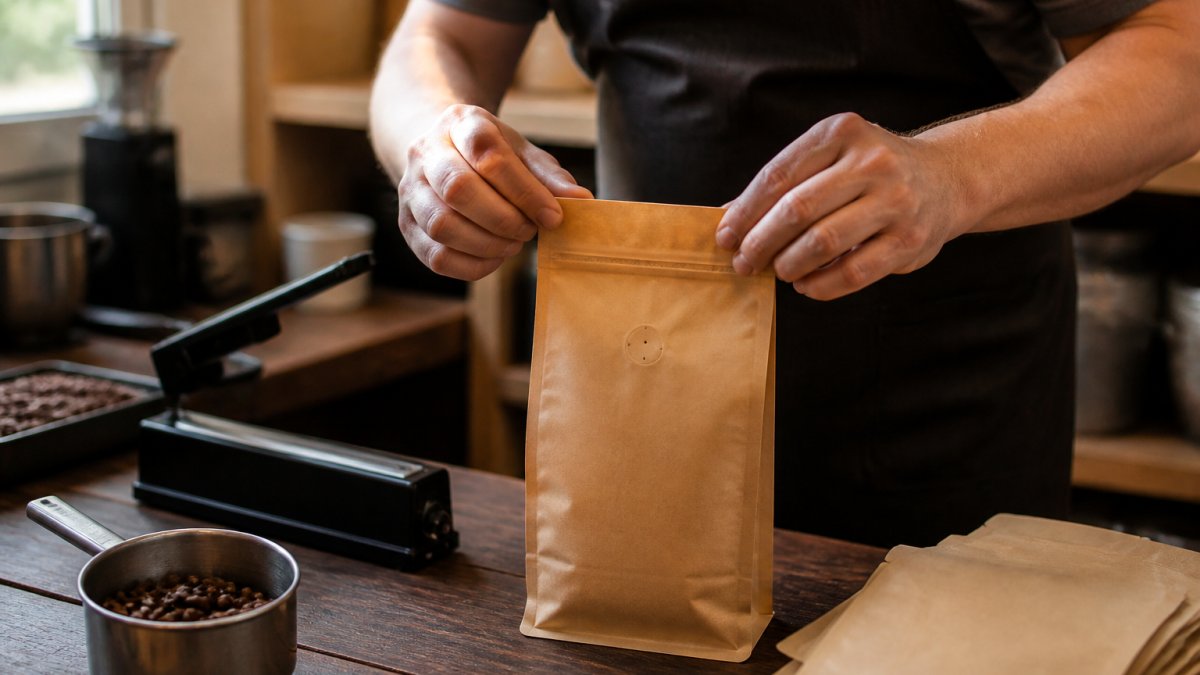
Coffee bag barrier properties decide whether your beans taste fresh on day ten or flat by day three. Test before you print a single bag, not after.
Oxygen, Moisture, and Aroma Protection
Oxygen is the enemy. It turns bright roast notes stale and flat. Moisture invites mold and kills the snap of a good bean.
Ask your supplier for oxygen transmission rate data on the finished bag, not just the film.
Run a simple shelf test. Fill sample bags, seal them, store them at room temperature, and taste at intervals. Compare against your current packaging.
The freshness chemistry behind roast-to-order coffee is worth understanding before you judge barrier needs. Our piece on why roast-to-order coffee tastes different explains the timing that makes barrier choice so consequential.
Valves, Zippers, and Accessories That Keep Coffee Fresh
Every accessory has to earn its place, because each one is a potential compostability failure point.
- Degassing valve: releases carbon dioxide without letting oxygen in. Essential for fresh-roasted beans.
- Zipper: keeps the bag resealable. Look for compostable zipper stock.
- Tin tie: a compostable alternative to plastic closures for smaller bags.
A common mistake is sourcing a certified bag, then adding a plastic valve or a foil label. The bag no longer matches its certification. Audit every component, not just the film.
Step 5: Get Compostable Packaging Labeling and Certification Right
Compostable packaging labeling is where good intentions meet legal risk. You cannot call a bag compostable without third-party proof, and the proof has to match the specific disposal environment you name on the bag.
Know the Standards Behind the Marks
In the United States, compostability claims are often substantiated against ASTM International standards, such as the ones described below:
- ASTM D6400 covers plastics designed to be composted in municipal and industrial aerobic composting facilities. It sets pass/fail criteria for disintegration, biodegradation, and ecotoxicity, plus limits on heavy metals.
- ASTM D6868 covers paper and other substrates coated or laminated with biodegradable plastics. If your bag has a paper outer layer and a compostable film barrier, this is often the relevant standard.
For home compostability, there is no single federal standard, but third-party programs such as the Biodegradable Products Institute (BPI) and the Compost Manufacturing Alliance (CMA) run verification programs. Third-party programs such as BPI and CMA offer verification; check each program's current requirements directly. The U.S. Composting Council's certification program maintains a searchable list of certified products, which is a fast way to verify a supplier's claim.
Build a Claims Checklist Before You Print
Use this checklist to keep every claim defensible:
- The finished bag, not just the film, holds a current certificate from a recognized program
- The certificate names the standard (ASTM D6400 or D6868) and the disposal environment (industrial or home)
- Every component (valve, zipper, label, adhesive, ink) is covered by that certificate or separately certified
The Federal Trade Commission's Green Guides set the baseline for environmental marketing claims: qualifications must be clear, prominent, and not misleading. A compostable claim without a named disposal environment is exactly the kind of qualified claim the Green Guides warn against. The Environmental Protection Agency's guidance on compostable products reinforces that compostable items belong in composting systems, not the trash, say so plainly on the bag.
Verify, Don't Trust
Ask suppliers for the certificate number and the certifying body, then look it up yourself in the certifier's public database. A supplier who dodges the certification question is telling you something. Walk away.
Step 6: Compare Cost, Minimum Order Quantities, and Suppliers
Compostable bags generally cost more than conventional packaging, which can affect how you plan a product launch. Pricing depends on material mix, print method, order size, and delivery terms, so request current pricing or a quote from Smokin Java's website before comparing suppliers.
What Drives the Cost
- Material mix: multi-layer compostable structures with a high-barrier film cost more than single-layer kraft. The barrier layer is usually the most expensive component.
- Print method: flexographic printing is cheaper at volume; digital printing has lower setup costs and suits short runs and frequent design changes.
- Order quantity: unit cost drops sharply as volume rises, but minimum order quantities (MOQs) can be steep for small roasters.
Supplier Evaluation Checklist
Compare suppliers on these points, and ask for documentation on each:
- Certificate number and certifying body for the finished bag, verifiable in the certifier's public database
- Barrier test data (oxygen transmission rate) on the finished construction, not just the film
- MOQs and whether they flex for small roasters or offer stock programs
A supplier who dodges the certification question is telling you something. Walk away.
Plan for the Transition
A practical pattern many roasters follow: run a small pilot with plain or digitally printed stock bags to validate barrier performance and customer response, then commit to a larger flexographic run once the design and material are proven. This staged approach lowers the risk of a costly print run on a bag that fails your shelf test.
Step 7: Write Disposal Instructions Customers Can Actually Follow
Disposal instructions are the last mile, and most brands blow it. A bag that confuses the customer ends up in the wrong bin.
Write short, specific steps:
- Name the disposal route: home bin or municipal organics program
- Tell customers to remove any non-compostable add-ons
- Note that the bag breaks down slowly, not overnight
Test the instructions on someone outside your team. If they hesitate, rewrite.
Choosing the Right Compostable Bag for Your Next Roast
Match the bag to the customer, not to the trend. Local buyers with backyard bins get home compostable. Municipal-program customers get industrial compostable. Everyone gets tested barrier performance and honest labels.
Pair that packaging with beans worth protecting. Our best organic coffee beans for French press brewing guide helps you pick a roast that deserves the effort, and our rundown of the benefits of freshly roasted coffee beans shows what you're protecting.
At Smokin Java, we roast the day it ships, source organic beans, and use eco-friendly packaging practices. Browse our coffee and add to cart to taste fresh, responsibly packed coffee for yourself.
Frequently Asked Questions
What makes a coffee bag compostable?
A bag is compostable when every component, including the film, sealant, valve, and zipper, breaks down into non-toxic compost under defined conditions. Plant-based materials like kraft paper and compostable films are common, but the whole construction has to pass a recognized compostability standard. A bag with a conventional plastic valve or liner is not compostable as a unit, which is why roasters should confirm certification for the complete package, not just the outer layer.
Do compostable coffee bags keep coffee fresh?
They can when the barrier properties are right. Coffee stales mainly through oxygen exposure and moisture pickup, so a compostable bag needs an oxygen barrier, a moisture barrier, and a one-way degassing valve to release carbon dioxide without letting air in. Ask suppliers for barrier performance data and run your own shelf-life checks on a sample batch. Thin compostable films without a barrier layer will let coffee go flat faster than a high-barrier conventional bag.
How can coffee roasters verify compostability claims?
Ask for the certificate, not just the marketing line. A legitimate claim references a recognized compostability standard and names the certifying body, the certification number, and whether the approval covers home composting, industrial composting, or both. Verify the certificate is current and lists the exact bag construction you are buying, including valves and zippers. If a supplier cannot produce documentation for the finished package, treat the claim as unverified.
How should customers dispose of compostable coffee packaging?
It depends on the certification. Home compostable bags can go into a backyard compost bin, ideally torn or cut open to speed breakdown. Industrial compostable bags need a municipal or commercial composting facility, so check whether your local program accepts them. Remove labels and tin ties if they are not certified, and never put compostable bags in the recycling bin, where they contaminate the plastic stream. Clear on-pack disposal instructions prevent the most common mistakes.
The hard part isn't choosing a compostable bag. It's choosing one that protects flavor, survives shipping, and breaks down where your customers actually live. Smokin Java roasts each batch the day it ships, uses locally organic roasts, and builds eco-friendly packaging practices around real disposal outcomes. Get started with Smokin Java and taste the difference fresh, responsibly packed coffee makes in your daily cup.
