

Table of Contents
- What Makes Coffee Packaging Compostable
- Industrial vs Home Compostable Coffee Bags
- BPI Certified Compostable Packaging Standards
- The Hidden Sustainability Trade-Offs
- How to Reduce Coffee Carbon Footprint Beyond Packaging
- Greenwashing Red Flags in Coffee Packaging Claims
- Making Informed Choices About Your Coffee Packaging
- Frequently Asked Questions
Last Updated: September 23, 2026
What Makes Coffee Packaging Compostable
Compostable coffee packaging is specifically engineered to break down in composting environments through microbial action, but the term masks significant complexity. Most coffee bags claiming compostability aren't actually the same product, they're built differently depending on whether they're designed for industrial facilities or home compost piles.
Compostable coffee bags typically use polylactic acid (PLA), a bioplastic derived from renewable resources like corn starch, to replace petroleum-based polymers. However, PLA alone doesn't solve the coffee packaging problem, it requires specific conditions to break down effectively.
The role of bioplastics and PLA in compostable bags
PLA breaks down only under specific temperature and moisture conditions that don't exist in most home compost bins. Just because a bag says "compostable" doesn't mean your backyard pile will actually decompose it.
PLA requires sustained temperatures above 135°F (57°C), which home compost rarely reaches. Industrial composting facilities actively manage heat and moisture to create ideal conditions. This explains the two distinct labels: "industrially compostable" and "home compostable", different materials for different environments.
PLA reduces fossil fuel dependence but fragments into microplastics before fully decomposing, a growing concern as more compostable bags enter the waste stream.
Multi-layer barriers, valves, and tin ties
A coffee bag must simultaneously keep oxygen out, let carbon dioxide escape, maintain shelf-life integrity, and decompose cleanly in compost, contradictory requirements that complicate design.
Multiple material layers, kraft paper, PLA film, and sometimes metallized film, serve different purposes but don't separate easily during composting and decompose at different rates.
Degassing valves, which allow CO2 to escape while blocking oxygen, typically contain non-compostable plastic or synthetic rubber and remain as fragments in finished compost.
Tin ties must be removed before composting, but most consumers don't know this, causing contamination at facilities.
Industrial vs Home Compostable Coffee Bags
The distinction between industrial and home compostable coffee bags isn't semantic, it's the difference between a bag that will actually decompose and one that will sit intact in your backyard for years.
What industrial composting requires
Industrial composting facilities operate at 131-158°F with controlled moisture and aeration, breaking down PLA into CO2, water, and biomass over weeks.
In the United States, ASTM D6868 is the primary standard, testing whether materials biodegrade within 180 days into fragments smaller than 2mm with no toxic residues.
Industrial facilities can process multi-layer materials through grinding and shredding, making them the realistic destination for most compostable coffee bags.
Industrial composting capacity is limited, and many facilities reject coffee bags as contamination risks, creating a gap between packaging claims and actual availability.
Home composting feasibility and reality
Home composting is fundamentally different from industrial composting. Most home compost piles operate at temperatures between 40°F and 100°F (4-38°C), well below the 135°F threshold where PLA begins to degrade. Even in active compost piles with regular turning, reaching and maintaining industrial-level temperatures is nearly impossible.
The result: bags labeled "home compostable" are rare, and bags labeled "industrially compostable" will not break down in home systems. This is the uncomfortable truth most guides avoid stating directly. If you throw a compostable coffee bag into your backyard compost, it will likely still be there in recognizable form years later.
Home compostable bags do exist, and they use different materials, typically materials that degrade at lower temperatures. But they're less common in the coffee industry because they offer inferior barrier properties. A bag that breaks down in home compost often can't protect coffee beans effectively for the months-long shelf life consumers expect.
This creates a real dilemma for ethically conscious coffee drinkers. The bag that's marketed as sustainable may be genuinely unsustainable for your specific situation if you lack access to industrial composting facilities.
BPI Certified Compostable Packaging Standards
The Biodegradable Products Institute (BPI) is the primary certifier of compostable packaging in the United States. A BPI certification means the product has been tested and verified to meet ASTM D6868 standards for industrial composting. It's the closest thing to a guarantee that a compostable bag will actually decompose in the right environment.
However, BPI certification comes with a critical caveat: it certifies the material, not the finished product. A coffee bag with a BPI-certified film might still contain non-compostable components like the degassing valve, tin tie, or adhesives. Some manufacturers claim their bags are "BPI certified" when only the film layer carries the certification.
Looking for the BPI logo on packaging is a reasonable first step, but it's not sufficient due diligence. You also need to verify what components are included and whether those components are actually certified. Many compostable coffee bags fail this deeper inspection.
The certification process itself has limitations. ASTM D6868 tests whether materials biodegrade in controlled industrial conditions, but it doesn't assess the broader environmental impact of producing those materials, transporting them, or managing them at end-of-life. A certified compostable bag might still have a higher carbon footprint than a conventional recyclable alternative, depending on sourcing and logistics.
The Hidden Sustainability Trade-Offs
This is where compostable coffee packaging reveals its true complexity. The decision to use compostable materials isn't a simple "good" choice, it involves trade-offs that most sustainability marketing glosses over.
Recyclability versus compostability
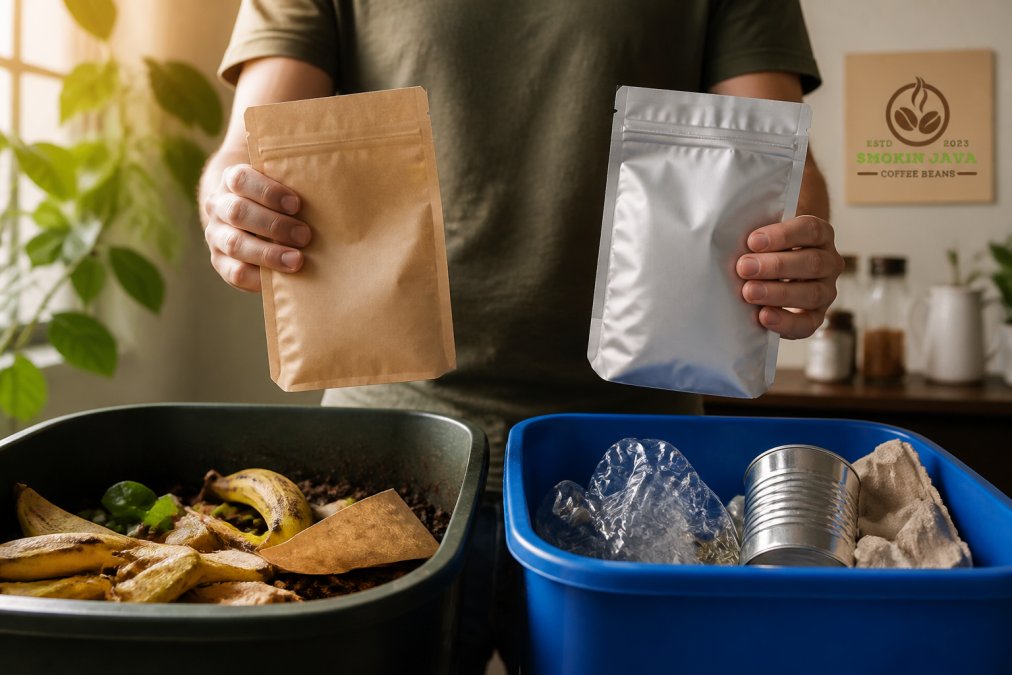
Here's the uncomfortable reality: a bag optimized for composting is often poorly suited for recycling, and vice versa. Multi-layer compostable bags contaminate recycling streams. Recycling facilities rely on material sorting, and bags made from mixed PLA and kraft paper jam equipment or end up as contaminants in sorted batches.
Conversely, bags optimized for recycling, typically aluminum or metallized plastic, cannot be composted. They're designed for the mechanical recycling process, which requires specific material types and properties.
The choice between recyclability and compostability isn't neutral. It depends entirely on what infrastructure exists in your region. If your area has strong industrial composting but limited plastic recycling capacity, compostable bags make sense. If the opposite is true, recyclable bags are the better choice. Most consumers don't know what infrastructure serves their area, so they default to whatever label sounds most sustainable.
Microplastic contamination concerns
PLA degrades into microplastics before fully mineralizing into CO2 and water. In industrial composting facilities, these microplastics are theoretically managed through screening and removal. In practice, some escape into the finished compost product.
When that compost is applied to agricultural soil, microplastics persist. They accumulate in soil ecosystems, affecting microbial communities and potentially entering the food chain. The long-term consequences of microplastic accumulation in agricultural soils are not yet fully understood, but early research suggests the effects are not neutral.
This creates a perverse outcome: using a "compostable" bag to feel environmentally responsible may actually introduce persistent contaminants into soil systems. The marketing narrative of "returning to soil" obscures the reality of fragmentation and persistence.
Decomposition timelines and toxic residues
Industrial composting certification requires that materials break down within 180 days and leave no toxic residues. The testing is real, but the real-world conditions are often different. Composting facilities operate at variable temperatures and moisture levels. Some batches may not reach optimal conditions, extending decomposition timelines significantly.
Additionally, the adhesives, inks, and dyes used on compostable coffee bags may not fully degrade alongside the base material. Some of these components persist in the finished compost as residues. The certification tests for "no toxic residues," but toxicity thresholds are determined by regulatory standards, not by ecological impact. A substance might be below the regulatory threshold but still harmful in accumulated quantities.
How to Reduce Coffee Carbon Footprint Beyond Packaging
The obsession with compostable packaging often obscures the larger sustainability picture. The packaging represents a small fraction of a coffee product's total environmental impact.
The carbon footprint of coffee production is dominated by farming practices, processing, transportation, and roasting. A bag's material contributes far less to overall impact than how the coffee inside was grown and shipped. Choosing single-origin coffee from a producer using shade-growing practices and regenerative agriculture typically reduces environmental impact far more than switching to compostable packaging.
Transportation distance matters significantly. Coffee shipped by air has a dramatically higher carbon footprint than coffee shipped by sea. Subscription models that consolidate shipments reduce per-unit transportation emissions. Locally roasted coffee, when available, eliminates some transportation steps entirely.
At Smokin Java, we prioritize roasting coffee the day it ships, which reduces the need for extended shelf-life packaging.
Greenwashing Red Flags in Coffee Packaging Claims
Compostable packaging has become a marketing tool, and the marketing often misleads. Several red flags should trigger skepticism.
Making Informed Choices About Your Coffee Packaging
The decision about coffee packaging should be based on what's actually available and practical in your situation, not on marketing narratives.
Frequently Asked Questions
Do compostable coffee bags actually compost in home bins?
Most compostable coffee bags require industrial composting temperatures of 140°F or higher to break down within 90-180 days. Home compost piles typically reach only 100-120°F, meaning bags labeled 'compostable' may not fully decompose in your backyard. Check for 'home compostable' certification specifically, these are rare in the coffee industry. Without the right conditions, bags can persist for years, creating a false sense of sustainability.
What does BPI certified compostable packaging actually guarantee?
BPI (Biodegradable Products Institute) certification confirms that packaging meets ASTM D6868 standards for industrial composting. It verifies the material will decompose within 180 days at certified facilities and leave no toxic residues. However, BPI certification does not guarantee your local composting facility accepts coffee bags, nor does it mean the bag is home-compostable. Always verify your regional composting infrastructure accepts BPI-certified materials before purchasing.
How much does compostable coffee packaging actually reduce carbon footprint?
Compostable packaging itself has a similar or sometimes higher carbon footprint than conventional plastic during production. The real benefit comes from landfill diversion, compostable bags in industrial facilities generate compost instead of methane. However, shipping weight, roasting method, and sourcing distance typically contribute far more to overall coffee carbon impact than packaging choice. Buying from local roasters or reducing consumption frequency has greater environmental impact than switching packaging alone.
What should I look for to avoid greenwashing in coffee packaging claims?
Verify third-party certifications like BPI, USDA Organic, or Fair Trade on the bag itself, not just marketing claims. Ask whether your local composting facility actually accepts the material; many don't despite 'compostable' labels. Check if the brand discloses decomposition timelines, barrier materials, and valve composition. Brands committed to sustainability provide specific details about industrial requirements and acknowledge home-composting limitations rather than implying universal compostability.