
Last Updated: October 27, 2026
Quick Summary
Single origin coffee is coffee traced to one specific place, and the label can point to anything from a country down to a single farm. The term has no legal standard behind it in the United States, so a roaster can print it on almost anything.
- A bag labeled simply Colombia can blend beans from multiple smallholders across the country.
- Blends combine beans from multiple origins to hit a consistent flavor profile, batch after batch.
- Read origin, producer, variety, process, elevation, and roast date, in that order.
- Start brewing at 1 part coffee to 16 parts water by weight, then adjust one variable per brew.
- Buy only as much coffee as you'll drink in two to three weeks and store beans whole and airtight.
Table of Contents
- What Single Origin Coffee Beans Actually Means
- Single-Origin vs. Blend Coffee: What Changes in Your Cup
- Single-Origin Coffee Flavor Profiles and What Drives Them
- How to Read a Coffee Bag Label Before You Buy
- How to Brew Single-Origin Coffee So Its Character Shows
- Best Single-Origin Coffee Beans to Start With
- Freshness, Storage, and Buying the Right Amount
- Build Your First Single-Origin Order with Smokin Java
- Frequently Asked Questions
What Single Origin Coffee Beans Actually Means
Single origin coffee is coffee traced to one specific place, and the label can point to anything from a country down to a single farm. That's the whole definition, and it's also the problem: the term has no legal standard behind it in the United States, so a roaster can print it on almost anything.
At Smokin Java, we source beans from named growing regions and roast each batch to order, which is why the origin on the bag matters to us more than a marketing claim. Below, we'll show you exactly how to read that label, brew what you buy, and choose beans you'll actually want a second bag of. But first, here's what most guides get wrong: they treat "single origin" as a quality grade. It isn't. It's a statement about geography, nothing more.
Country, Region, Farm, or Producer: How Narrow the Label Gets
The word "single" hides a lot of range. A bag labeled simply "Colombia" can blend beans from multiple smallholders across the country. A bag labeled with a single farm or estate narrows it to one producer's crop. Regional labels, like a specific growing zone, sit in between.
Narrower isn't automatically better, but it is more specific. When a bag names a cooperative or a single producer, you can trace the coffee back to a real place and a real harvest. That traceability is the point of the whole category. A common mistake is assuming a country-level label means one farm. It usually means one country, and that's it.
Single-Origin vs. Blend Coffee: What Changes in Your Cup
Blends combine beans from multiple origins to hit a consistent flavor profile, batch after batch. Single-origin coffee lets one place speak for itself, so the cup changes with the harvest.
Single-origin coffee is associated with one coffee-growing region's soil, elevation, and climate rather than a formula.
Is single origin coffee too intense? A practical guide walks through what to expect and which origins suit a milder palate.
| Factor | Single-Origin | Blend |
|---|---|---|
| Flavor | Distinctive, changes by harvest | Consistent, balanced |
| Traceability | High, often to farm level | Low to moderate |
| Best for | Exploring flavor | Reliable daily cup |
| Price | Varies by origin | Usually steadier |
Single-Origin Coffee Flavor Profiles and What Drives Them
Flavor in single-origin coffee is associated with where the coffee grew, how high it grew, which variety it is, and how it was processed.
Our Ethiopia Natural has tasting notes of milk chocolate, fruit, and caramel, and is made with indigenous heirloom cultivars from Sidama Zone.

Terroir, Elevation, and Processing: Why One Region Tastes Different
Terroir is the combined effect of soil, climate, altitude, and weather on a coffee's flavor.
How to Read a Coffee Bag Label Before You Buy
A coffee bag label can provide information about its contents. Read it in a fixed order rather than scanning for buzzwords.
The Six Fields That Matter, In Order
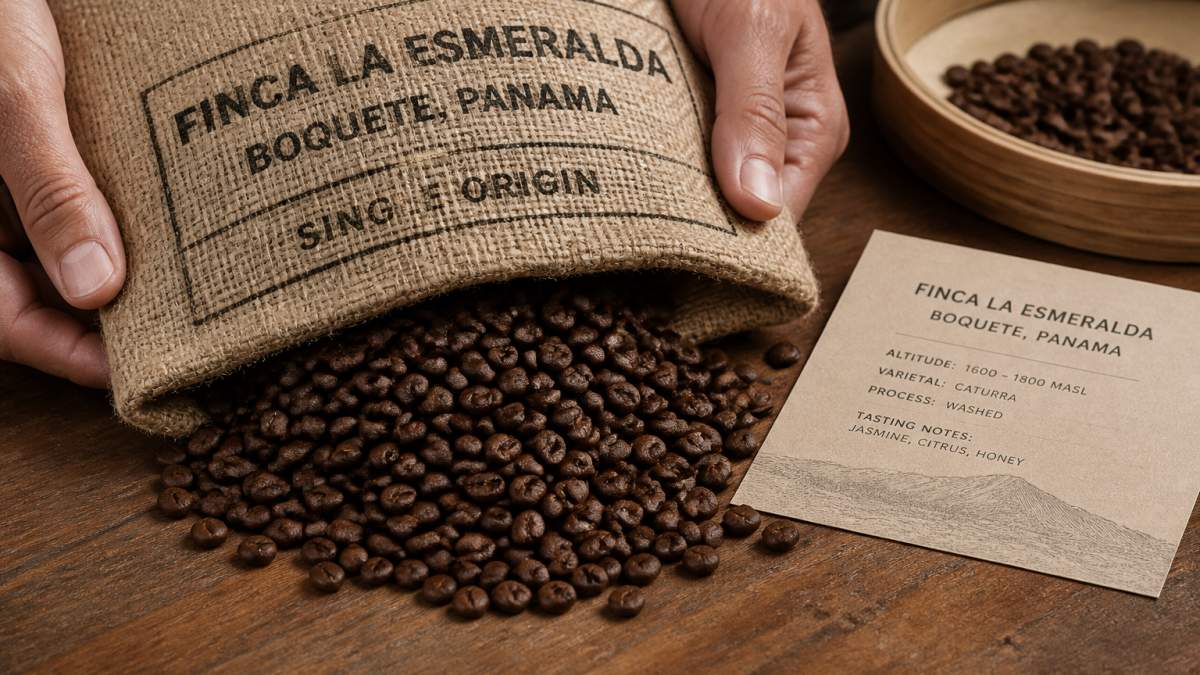
- Origin, as narrowly as it goes. "Colombia" is a country-level claim. "Huila" is a region. "Finca La Esperanza, Huila" is a farm. The narrower the name, the more specific the coffee.
- Producer or cooperative. Look for a named farm, estate, or cooperative.
- Variety. Bourbon, Typica, Catuai, Caturra, Gesha, SL28, variety is genetics. A bag that lists variety provides that information.
- Process. Washed, natural, honey, anaerobic, processing is another detail to look for on a label.
- Elevation. Printed in meters above sea level, often as a range.
- Roast date. Not a best-by date. A roast date is a date associated with roasting.
What a Label Cannot Tell You
The single-origin label has no legal standard behind it in the United States. The checklist above can help you assess the information a roaster chose to disclose.
Practice on a Real Label
Our Brazil Santos is a good label to practice on: it names the region, the growers, the varieties, the altitude, and the process.

How to Brew Single-Origin Coffee So Its Character Shows
The goal is not a complicated recipe, it is a repeatable starting point plus one variable changed at a time.
Start With a Ratio, Then Adjust
A starting point is 1 part coffee to 16 parts water by weight, for example, 20 grams of coffee to 320 grams of water. From there, adjust in small steps:
- Too weak or thin? Tighten the ratio toward 1:15 before you change anything else.
- Too strong or muddy? Loosen toward 1:17.
- Sour and sharp? Grind finer or raise water temperature slightly.
- Bitter and drying? Grind coarser or lower water temperature slightly.
Change one variable per brew. If you change grind and ratio together, you will not know which one fixed the cup.
Grind and Temperature by Method
| Method | Grind | Water Temp | Starting Ratio |
|---|---|---|---|
| Pour-over (cone) | Medium-fine, like table salt | Just off the boil | 1:16 |
| Drip brewer | Medium | Just off the boil | 1:16 |
| French press | Coarse, like sea salt | Just off the boil | 1:15 |
| Espresso | Fine, dialed to the basket | Just off the boil | By yield, not ratio |
Espresso concentrates everything, so dial toward a yield you like rather than chasing a fixed ratio.
Match the Method to the Origin
The method is not a rule, it is a lever you can pull to explore the qualities you already like.
Keep Notes
Write down the origin, the roast date, the ratio, the grind setting, and the brew time for each cup. Your notes can help you keep track of which origins and methods you prefer.
Best Single-Origin Coffee Beans to Start With
Start with a sampler if you're new. Tasting several origins side by side lets you sample them together.
Our Single Origin Favorites Sample Pack includes six single-origin coffees in 2-ounce packs. It's a way to sample multiple coffees.
Freshness, Storage, and Buying the Right Amount
Buy only as much coffee as you'll drink in two to three weeks. Coffee is best in the first weeks after roasting and fades steadily after that, no matter how well you store it.
Store beans whole in an airtight container away from light and heat, and grind right before brewing. Skip the freezer for daily-use coffee; the repeated temperature swings do more harm than good. Buy smaller bags more often rather than a large bag you'll finish in two months. This is why we roast to order: the clock starts when the beans ship, not when they sit in a warehouse.
Build Your First Single-Origin Order with Smokin Java
Start with a sampler, note which origin you reach for first, then buy a full bag of that one.
At Smokin Java, we roast each batch the day it ships and source organic beans from named growing regions. Our sample pack lets you compare coffees.
Get started with Smokin Java and explore our Bali Blue.

Frequently Asked Questions
What does single origin coffee mean?
Single origin coffee is coffee associated with one defined place, such as a country, region, farm, or producer. Check the label for region, grower, variety, altitude, and process to see what details it provides.
Is single-origin coffee better than blended coffee?
Neither is better in every case. Single-origin coffee is associated with one place, while blends combine beans from multiple origins. The single-origin vs. blend coffee decision comes down to which option you prefer.
What does single-origin coffee taste like?
Flavor can vary with growing conditions, coffee variety, and processing method. Smokin Java's Ethiopia Natural is listed with milk chocolate, fruity, and caramel tasting notes.
Are single-origin coffee beans always Arabica?
The product listings provided here identify varieties for some coffees but do not specify their species.
How should you brew single-origin coffee?
A ratio near 1:16 coffee to water by weight is one possible starting point. Keep notes on each change to track your preferences.
How can you tell where single-origin coffee beans come from?
Read the bag for details such as country, region, farm, estate, cooperative, or producer. A label may also list grower, variety, altitude, processing method, or harvest year. A roast date and a named region are additional details to look for.
