
Table of Contents
- Why Buy Freshly Roasted Organic Coffee Online in 2026
- Bali Blue, Mexico, Peru: Single-Origin Organic Beans Reviewed
- How to Tell If Coffee Beans Are Fresh
- How to Store Organic Coffee Beans So They Stay Fresh
- Organic vs Non-Organic Coffee Health Benefits
- Sample Packs, Pricing, and Shipping Frequency
- Which Organic Coffee Should You Order First?
- Frequently Asked Questions
Last Updated: October 2, 2026
Why Buy Freshly Roasted Organic Coffee Online in 2026
If you want to buy freshly roasted organic coffee online, the roast date matters more than the label. Coffee is at its best within days of roasting, not weeks or months. Most grocery store bags sit in a warehouse long before they hit a shelf, and by the time you brew them, the oils have gone flat and the aroma has faded.
Bali Blue, Mexico, Peru: Single-Origin Organic Beans Reviewed
Single-origin coffee comes from one region, one harvest, and often one group of farms. That traceability is the whole point. You taste the place, not a blend designed to hit the same note every year.
| Coffee | Roast Level | Tasting Notes | Region | Price |
|---|---|---|---|---|
| Bali Blue | Med-dark | Dark chocolate, molasses, brown sugar | Kintamani, Bali | $18.99 |
| Mexico | Medium | Chocolate, cinnamon, green apple | Chiapas and Oaxaca | $18.99 |
| Peru | Medium | Salted caramel, silky sweet, citrus | Piura, Amazonas | $18.99 |
Bali Blue: Dark Chocolate and Molasses in a Med-Dark Roast
Bali Blue is the boldest of the three. Smallholder farmers in Kintamani grow Bourbon, Typica, and Catimor varieties on volcanic loam between 1,200 and 1,600 meters, then hand-pick and wet-hull each lot. The med-dark roast pulls out dark chocolate and molasses, with brown sugar rounding off the finish.


Mexico and Peru: Medium Roasts for Everyday Drinking
Mexico is the easygoing one. Grown in Chiapas and Oaxaca, it lands on chocolate and cinnamon with a green apple snap at the end. Fully washed and sun dried, it's a clean cup that works with any brewing method.
How to Tell If Coffee Beans Are Fresh
Fresh coffee beans have a visible roast date, smell strongly of the roast, and feel dry rather than oily on the surface. If a bag lists only a "best by" date, you have no way to know when it was roasted.
A few things to check before you buy:
- Roast date, not expiration date. Roasted-on dates tell you everything. Best-by dates tell you almost nothing.
- One-way degassing valve. Fresh beans release carbon dioxide. A valve lets gas escape without letting oxygen in.
- Whole bean over ground. Grinding exposes far more surface area to oxygen. Whole beans hold their flavor longer.
- Aroma on opening. Fresh beans hit you immediately. Stale beans smell like paper.
How to Store Organic Coffee Beans So They Stay Fresh
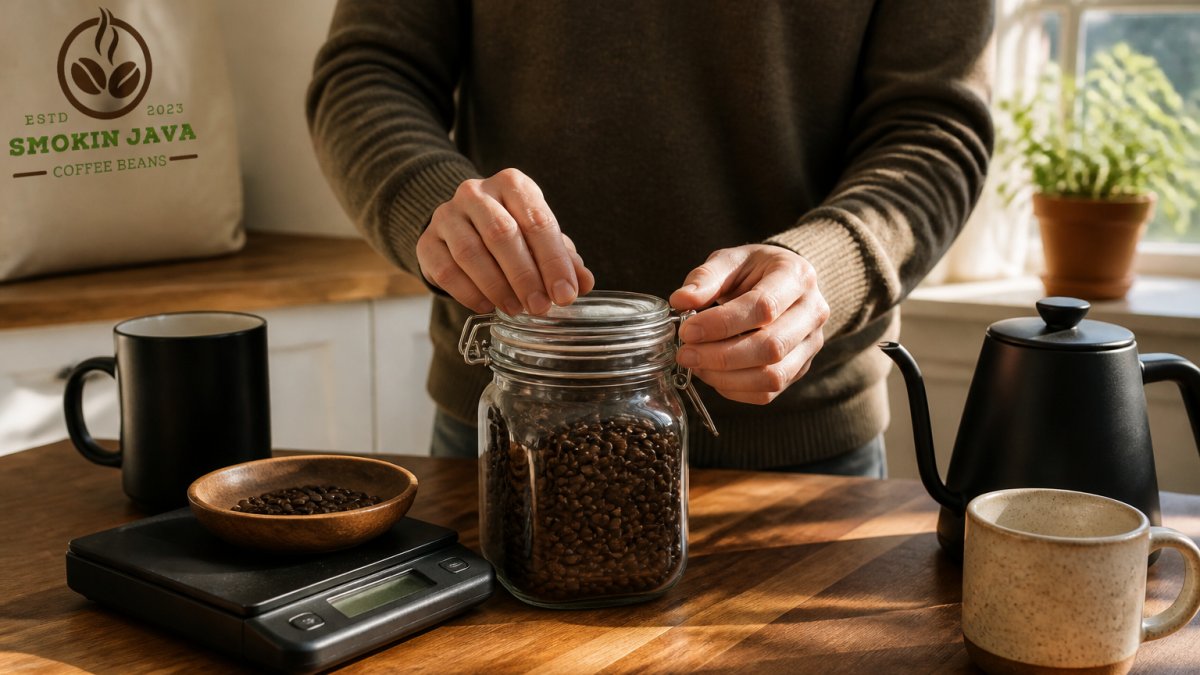
Store organic coffee beans in an airtight, opaque container at room temperature, away from light, heat, and moisture. Skip the fridge and the freezer for daily-use beans. Both introduce condensation every time you open the container.
Organic vs Non-Organic Coffee Health Benefits
The main difference between organic and non-organic coffee is how the crop is grown. Organic certification prohibits synthetic pesticides and fertilizers, and it requires buffer zones between organic fields and conventional ones. For many buyers, the appeal isn't a specific health outcome. It's reducing exposure to residue and supporting farming practices that don't rely on synthetic inputs.
What "Clean Coffee" Testing Actually Covers
A meaningful quality program tests for three categories of contaminants:
- Mycotoxins (ochratoxin A and aflatoxin). These are mold-related compounds that can develop when cherries are dried or stored in humid conditions. Roasting reduces them substantially, but the starting point depends on how the beans were handled at origin. A roaster who controls the supply chain can verify drying and storage conditions rather than trusting a broker.
- Pesticide residue. Even certified organic imports can be tested for residue as a verification step. The point isn't that organic beans are contaminated, it's that independent lab results confirm the certification is doing its job.
- Heavy metals (lead, cadmium). Coffee plants can take up trace metals from soil. Testing at origin and at the roaster level gives you a data point the label doesn't provide.
How to Ask a Roaster About Testing
Most roasters publish nothing. The ones who do usually share one of three things: third-party lab certificates, a stated testing frequency, or a named lab partner. If you can't find any of that on a product page, email and ask two questions: Do you test for ochratoxin A, and can you share the most recent results? A roaster who tests will answer quickly.
Processing Method Matters as Much as the Label
Beans can carry mold-related compounds if they're poorly handled after harvest. Fully washed and sun-dried lots tend to have lower risk than natural-process lots stored in humid conditions, because the fruit is removed before drying. That doesn't make natural process unsafe, it means the drying and storage discipline matters more. Buying from roasters who list the process, the region, and the altitude for every offering gives you visibility into how the beans were handled before they ever reached the roaster.
Sample Packs, Pricing, and Shipping Frequency
Trying before committing is the smart move, and sample packs make that cheap. The Best Sellers Sample Pack gives you six 2-ounce packs for $24.99, including the 6Bean, Cowboy, and Breakfast blends plus Peru, Mexico, and Bali. If you already prefer single-origin, the Single Origin Favorites Sample Pack is the better pick at the same $24.99, covering Brazil Santos, Colombia, Costa Rica, Ethiopia, Honduras, and Tanzania.
Match the Roast to Your Brewing Method
Most buying guides stop at the bean. The roast level and the brewing method have to work together, or you'll blame the coffee for a problem the equipment caused.
| Brewing Method | Best Roast Match | Why It Works |
|---|---|---|
| French Press | Med-dark to dark (Bali Blue) | Full immersion and a metal filter let oils through, so a bolder roast stands up to the heavy body |
| Pour-over (V60, Chemex) | Medium (Mexico, Peru) | Paper filters strip oils; a medium roast keeps the acidity and clarity that make pour-over worth the effort |
| Espresso | Med-dark (Bali Blue) | Needs enough development to resist the pressure and produce a stable crema |
| Drip | Medium (Mexico) | Forgiving across grind sizes and brew times; the green apple snap survives the batch brewer |
| Cold brew | Medium to med-dark | Long extraction favors chocolate and caramel notes over delicate florals |
Grind Size and Freshness
Whole bean holds flavor longer because grinding exposes surface area to oxygen. If you buy pre-ground, match the grind to your brewer: coarse for French Press, medium for drip and pour-over, fine for espresso. Pre-ground coffee stales in days, not weeks, so buy it in the smallest quantity that fits your routine.
Shipping Frequency That Keeps Coffee Fresh
The practical rule is simple: order enough to last two to three weeks, then reorder. That keeps you inside the window where the coffee still tastes like it did on roast day. If you travel often, a subscription you can pause or skip beats a fixed monthly shipment you can't stop. If you drink one cup a day, a single 12-ounce bag lasts roughly two weeks at a standard 1:16 ratio, which lines up almost exactly with the reorder window.
Which Organic Coffee Should You Order First?
Start with the sample pack if you're unsure, and go straight to Bali Blue if you already know you like darker roasts. Mexico is the safest daily driver for someone who wants a reliable, uncomplicated cup, and Peru is the one to try if you lean toward sweeter, fruitier coffee.
Frequently Asked Questions
Where can I buy fresh roasted coffee online?
Look for a roaster that prints the roasting date on the bag and roasts to order rather than stocking shelves. Smokin Java roasts each batch the day it ships, so the bag you open was roasted within days, not months. Their single-origin lineup, including Bali Blue, Mexico, and Peru, starts at $18.99 per bag, and sample packs run $24.99 if you want to try several origins before committing to a full-size order.
How can you tell if coffee is freshly roasted?
Check the roasting date, not the best-by date. Freshly roasted whole beans smell sweet and complex when you open the bag, and they bloom, or puff up and bubble, when hot water hits the grounds. If the beans look oily and smell flat or papery, they have likely been sitting for months. Buying from a roast-to-order roaster removes the guesswork because the date on the bag is close to the day it arrives.
Is organic coffee healthier than non-organic coffee?
Organic coffee is grown without synthetic pesticides, which matters because coffee is a heavily sprayed crop in conventional farming. USDA certified organic beans also skip synthetic fertilizers, and many organic operations test for mycotoxins and pesticide residue as part of certification. The caffeine content is similar either way, so the main difference is what you avoid rather than what you gain. If you drink coffee daily, organic is the lower-exposure choice.
How should I store organic coffee beans to keep them fresh?
Keep whole beans in an airtight container away from light, heat, and moisture. A cupboard next to the stove is the worst spot; a cool pantry shelf is better. Buy in quantities you will finish within two to three weeks, and grind right before brewing. Freezing works for longer storage if you seal the bag tightly and let it come to room temperature before opening, which prevents condensation from degrading the beans.
What are the benefits of buying coffee roasted to order?
Coffee peaks in flavor roughly 4 to 14 days after roasting and fades steadily after that. Roast-to-order means your beans ship within a day or two of roasting, so you drink them near their peak instead of weeks past it. You also get a verifiable roasting date, fresher aroma and tasting notes, and less risk of stale, flat coffee. Smokin Java roasts the day it ships and seals each bag for transit.