

Table of Contents
- The Real Cost Drivers Behind Artisan Coffee Prices
- Specialty Coffee vs Commodity Coffee: What Sets the Price Apart
- Labor, Harvesting, and High-Altitude Farming Costs
- Roasting Precision, Small-Batch Production, and Freshness
- Supply Chain Transparency, Direct Trade, and Farmer Compensation
- Cost-Per-Cup and Consumer ROI: Is Artisan Coffee Worth It?
- How to Choose the Best Organic Coffee Subscription in 2026
- Frequently Asked Questions
Last Updated: September 25, 2026
The Real Cost Drivers Behind Artisan Coffee Prices
Artisan coffee is more expensive because it is grown, picked, processed, roasted, and shipped under conditions that commodity coffee never has to meet. A smaller yield, hand labor, and traceability all add cost before the coffee ever reaches a bag. That is the short answer to why is artisan coffee more expensive, and this guide from Smokin Java breaks down where each dollar actually goes.
Here is the part most price complaints miss: the gap between commodity and artisan coffee is not marketing. It is a different production system with different economics, and once you see the breakdown, the premium stops looking arbitrary.
Below, we'll walk through the cost drivers, the difference between specialty and commodity coffee, and how to judge what you are actually paying for.
Specialty Coffee vs Commodity Coffee: What Sets the Price Apart
Specialty coffee is coffee that scores 80 or higher on a 100-point scale graded by certified tasters known as Q-graders. Commodity coffee is everything below that threshold, traded largely on volume and price alone.
That single distinction drives most of the cost difference. Commodity beans are bought in bulk with little attention to origin or cup quality. Specialty beans are graded, cupped, and selected lot by lot, and each of those steps costs money.
The C-Price and Market Volatility
The C-price is the benchmark futures price for commodity-grade Arabica coffee, set on the ICE exchange in New York. It moves based on global supply and demand, currency fluctuations, and speculative trading, not on what it actually costs a farmer to grow coffee. When the C-price drops below the cost of production, commodity farmers absorb the loss. Many operate at a loss for years, which is one reason why younger generations leave coffee farming for more stable work.
Specialty and artisan producers often operate outside that benchmark, negotiating prices that reflect quality and cover actual production costs. A roaster buying a 90-point lot from a specific farm might pay two to three times the C-price, or more, depending on rarity and demand. That insulation is one reason artisan coffee costs more, and also why it can stay stable when commodity markets swing.
A common pattern is that specialty contracts include a fixed premium above the C-price, sometimes called a differential, that is agreed upon before harvest. This gives farmers predictable income and roasters predictable supply, but it also means the final retail price reflects that negotiated premium rather than the daily commodity ticker.
Grading, Cupping Scores, and Quality Control
Grading is the process of evaluating green coffee for defects, size, and consistency. Cupping is the tasting method used to score flavor. Both require trained specialists, and both add cost. A single Q-grader certification takes months of coursework and calibration, and roasters who employ them pay for that expertise.
A common mistake is assuming "artisan" and "specialty" mean the same thing. They overlap, but artisan refers to the method and scale of production, while specialty refers to a verified quality score. A roaster can be artisan without every lot scoring specialty-grade. That distinction matters when you are comparing prices: you are paying for the verification, not just the label.
Labor, Harvesting, and High-Altitude Farming Costs
Harvesting is the single most labor-intensive step in coffee production. Unlike mechanized commodity farms, high-altitude operations often pick cherries by hand because the terrain will not support machinery. Hand-picking also allows selective harvest, meaning only ripe cherries are taken, which improves cup quality but slows the process considerably.
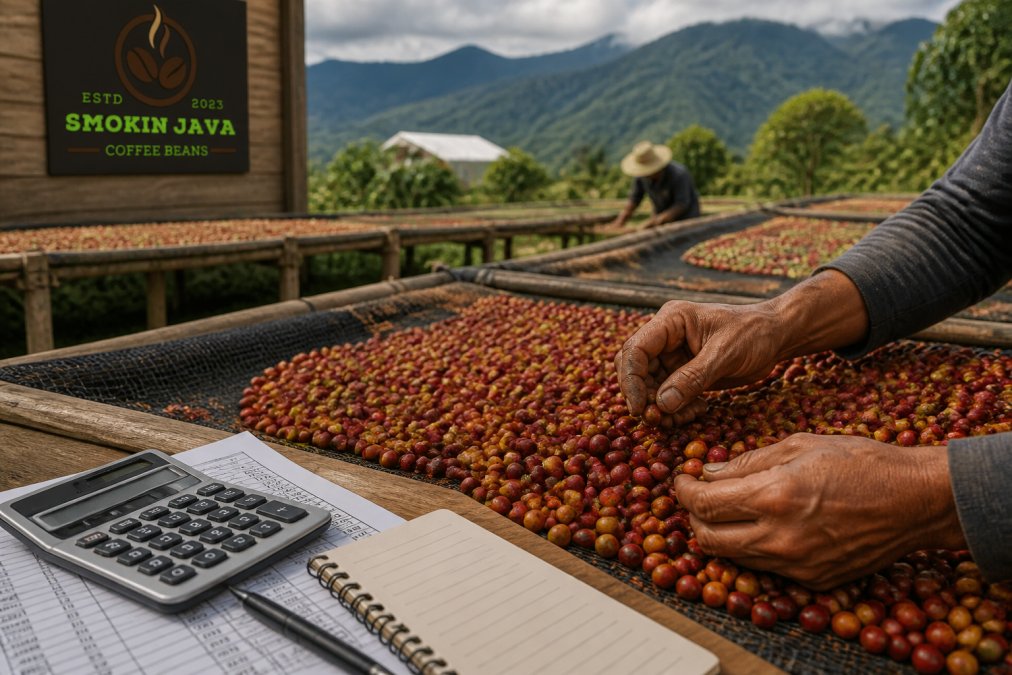
Altitude matters too. Higher elevations generally produce denser beans with more complex flavor, but the growing cycle is slower and yields are lower. Lower yield per acre means higher cost per pound. Add the logistics of moving coffee down from remote hillsides, and the labor and transport costs stack up fast.
Post-Harvest Processing Methods: Washed, Natural, and Honey
Processing method changes both flavor and cost:
- Washed: Fruit is removed before drying. Cleaner flavor, more water and labor required.
- Natural: Cherries dry whole with the fruit still attached. Fruitier profile, longer drying time, more risk of spoilage.
- Honey: Some fruit mucilage is left on during drying. Middle ground between the two, and tricky to execute consistently.
Natural and honey methods demand more careful monitoring, which raises production costs. Smokin Java's Ethiopia Natural ($18.99) is a good example of a full natural process, dried on raised beds and sorted by hand.

Roasting Precision, Small-Batch Production, and Freshness
Small-batch roasting is slower and less efficient than mass production, and that inefficiency is the point. A large commercial roaster runs continuous batches calibrated for consistency and shelf life. A small-batch roaster adjusts profiles batch by batch to bring out the best in a specific lot.
Roasting precision costs money in three ways: smaller equipment runs, more operator attention, and more coffee lost to test roasts. The payoff is a fresher, more expressive cup. Coffee roasted the day it ships simply tastes different from coffee that sat in a warehouse for months.
Where it falls short: small-batch roasting means less consistency between batches. If you find a lot you love, the next one may taste slightly different. That variability is a feature for some drinkers and a frustration for others.
Supply Chain Transparency, Direct Trade, and Farmer Compensation
Traceability means being able to follow a coffee from the farm to the bag. Hyper-traceable coffee names the specific farm, cooperative, or washing station, sometimes down to the lot. Building that chain requires relationships, travel, and record-keeping, all of which add cost.
Direct trade and fair trade are two different models for paying farmers better. Fair trade relies on third-party certification and a guaranteed minimum price. Direct trade skips the certification body and relies on the roaster's own relationships with growers. Both raise the price you pay, and both aim to make farming economically viable.
As documented in Fair Trade USA's certification standards, certification involves audits and compliance costs that farms and importers must absorb. That is not waste. It is what makes an ethical sourcing claim verifiable rather than decorative.
Smokin Java builds ethical partnerships with coffee farmers directly, which is how a lot like the Bali Blue ($18.99) can name its grower, region, altitude, and process instead of hiding behind a generic label.

Cost-Per-Cup and Consumer ROI: Is Artisan Coffee Worth It?
Cost-per-cup is the real comparison, not bag price. A $19 bag of artisan beans brewed at home typically yields far more cups than the same money spent at a café, and the per-cup math often lands below what you would pay for a single drip coffee out.
Here is the framework that matters:
| What You Are Comparing | What You Actually Pay For | Where Artisan Wins |
|---|---|---|
| Commodity bag | Volume, low unit cost | Nothing, on quality |
| Café cup | Convenience, labor, rent | Home brewing, on cost |
| Artisan bag | Traceability, freshness, craft | Flavor, ethics, per-cup value |
The consumer ROI question comes down to what you value. If coffee is fuel, commodity is fine.
How to Choose the Best Organic Coffee Subscription in 2026
Use this checklist before you commit:
- Does the roaster list a roast date or "roasted on order"?
- Can you verify organic certification, not just read the word "organic"?
- Does the listing name the farm, region, and process?
- Can you pause, skip, or cancel without a fee?
- Is the packaging actually compostable, or just labeled that way?
- What is the shipping window from roast to doorstep?
For a starting point, Smokin Java roasts each batch the day it ships, uses eco-friendly packaging, and publishes origin details for every lot. If you want a darker, bolder cup, the Italian Roast ($18.99) is a slow-roasted specialty-grade blend. If you want something unusual, the Whiskey Barrel Aged ($18.99) is a single-origin Guatemalan aged 30 days in a bourbon barrel.

Frequently Asked Questions
What factors contribute to the higher price of artisan coffee?
Artisan coffee costs more because of labor-intensive harvesting, high-altitude farming, small-batch roasting, and ethical sourcing. Farmers hand-pick cherries, which is slower and costlier than machine harvesting. Specialty beans often score 80+ on the cupping scale, requiring careful processing and grading. Roasters like Smokin Java roast to order, avoiding mass production waste. These steps raise production costs but deliver a fresher, more flavorful cup.
Is artisan coffee worth the extra cost compared to mass-market brands?
For many drinkers, yes. Artisan coffee offers traceability, fresher beans, and complex flavor profiles you won't find in commodity coffee. While a bag might cost more upfront, the cost-per-cup can be reasonable when you brew at home. Smokin Java's Bali Blue, for example, delivers dark chocolate and molasses notes at $18.99 per bag. If you value freshness and ethical sourcing, the premium is justified.
How do ethical sourcing and fair trade practices impact coffee pricing?
Ethical sourcing ensures farmers receive fair compensation, which increases the base cost of green coffee. Direct trade relationships cut out intermediaries, but still require paying a premium above the C-price to secure quality. This investment supports sustainable farming and better living conditions. Smokin Java partners directly with smallholder farmers, and those ethical partnerships are reflected in the final price you pay.
What is the difference between commodity coffee and specialty artisan coffee?
Commodity coffee is mass-produced, often blended from multiple origins, and priced based on the C-price. It prioritizes volume over quality. Specialty artisan coffee, by contrast, is graded 80+ by certified cuppers, traceable to a single origin or farm, and roasted in small batches. This focus on quality, transparency, and freshness explains why artisan coffee costs more per pound.