
Last Updated: November 12, 2026
Quick Summary
Shade grown coffee is coffee cultivated under a layer of taller native or companion trees that filter sunlight before it reaches the coffee plants. Coffee naturally grows as an understory shrub in forests, so this method keeps the crop closer to its original conditions. It is a trade-off, since these farms usually produce less coffee per acre.
- Shade grown farms usually produce less coffee per acre than open-sun fields.
- Cooler, filtered light tends to slow cherry development in shade-grown coffee.
- Shade grown" is largely a marketing phrase in the United States with no federal definition.
- Bird Friendly, run by the Smithsonian Migratory Bird Center, is a recognized shade standard requiring a verified canopy.
- Fair trade labels address farmer pay and labor conditions, not canopy cover.
Table of Contents
- Defining Shade Grown Coffee and How It Is Grown
- Shade Grown vs Sun Grown: How the Two Methods Compare
- How Shade Affects Coffee Plants, Cherries and Flavor
- Why Shade Grown Coffee Is Better for the Environment
- Reading the Shade Grown Coffee Label and Certifications
- Trade-Offs, Farmer Economics and Limits of Shade Grown Coffee
- Choosing Shade Grown Coffee Brands for Your Next Bag
- Frequently Asked Questions
Shade grown coffee is coffee that grows beneath a canopy of taller trees instead of in open, fully exposed sun. The method has a long history in coffee-growing regions, and it shapes the flavor, the farm's ecology and what you should look for on a bag. This guide explains what the term means, how the trees are arranged, how it compares with sun-grown coffee, and how to read labels when you shop.
Defining Shade Grown Coffee and How It Is Grown
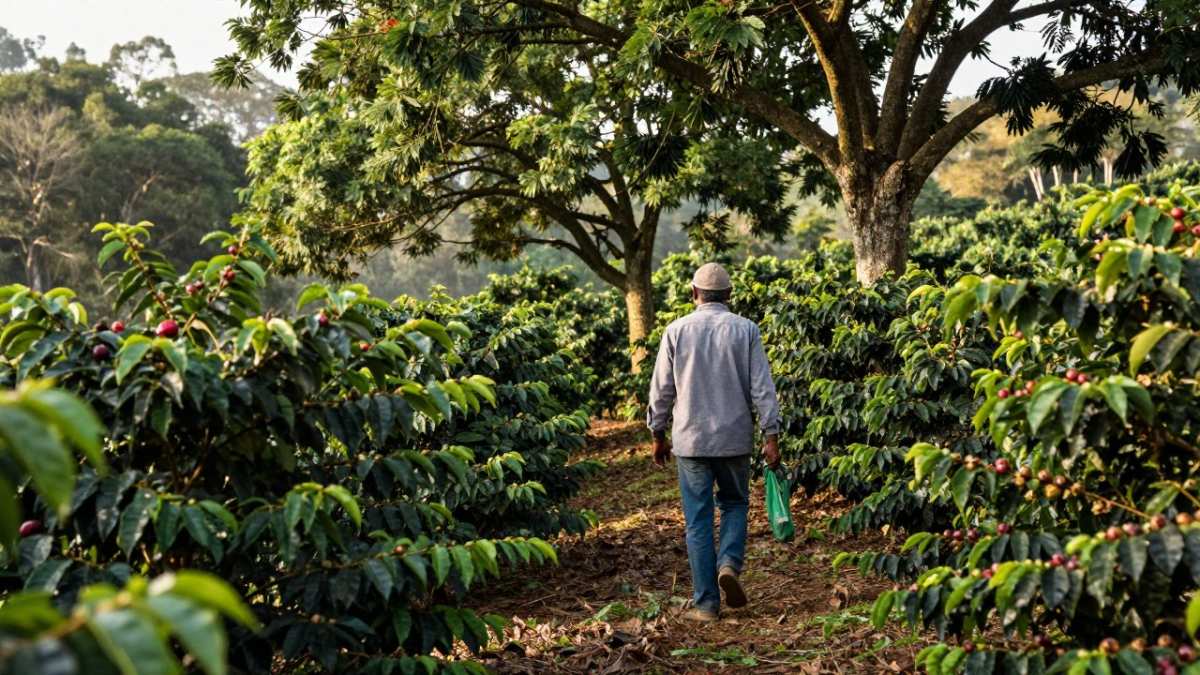
Shade grown coffee is coffee cultivated under a layer of native or companion trees that filter sunlight before it reaches the coffee plants. Coffee grows naturally as an understory shrub in forests, so shade-growing keeps the crop closer to those original conditions.
The Canopy Structure Farmers Build
Shade-grown farms typically plant a mix of tall trees with a middle layer beneath them, and the coffee bushes sit under this canopy. Several layers of cover tend to moderate the temperature and humidity around the plants compared with open fields.
Shade Grown vs Sun Grown: How the Two Methods Compare
Sun-grown coffee is planted in open fields with little or no tree cover. It usually produces higher yields per acre in the short term, but it typically depends more on chemical fertilizers, pesticides and irrigation to keep plants productive.
Shade-grown farms usually produce less coffee per acre, and that lower yield is a real trade-off for the farmer. In exchange, the plants tend to ripen more slowly and the soil and wildlife on the farm are better protected. Neither method is automatically better; the right choice depends on the farm's climate, labor and market.
How Shade Affects Coffee Plants, Cherries and Flavor
Cooler, filtered light tends to slow cherry development, and some roasters associate slower ripening with denser beans and more complex flavor.
Flavor outcomes vary with altitude, variety and processing as well as shade, so shade alone does not guarantee a particular taste. Treat it as one factor among several when you compare bags.
Why Shade Grown Coffee Is Better for the Environment
The main environmental case rests on habitat and soil. Shade canopies can create forest-like structure that supports wildlife such as birds and pollinators.
Reading the Shade Grown Coffee Label and Certifications
"Shade grown" is largely a marketing phrase in the United States. No federal regulation defines it, so a bag can carry the words with no canopy requirement behind them. The practical move is to look past the phrase and find a third-party standard that specifies shade cover and is verified by inspection.
What the Main Labels Actually Require
Bird Friendly, administered by the Smithsonian Migratory Bird Center, is a widely recognized shade standard that requires a verified canopy and organic management. Check the certifier's own materials for current requirements.
USDA Organic regulates farming inputs but does not address tree cover, so treat organic as a separate attribute from shade.
Fair trade labels (Fairtrade America and similar) focus on price floors, premiums, and labor conditions. They do not certify shade cover. A fair-trade bag tells you about farmer compensation, not canopy.
How to Verify a Claim
Start with the certifier's own database rather than the bag. Check the certifier's own public registry to confirm a claim, using the roaster or farm name.
Watch out: a roaster can legally print "shade grown" with no certification at all, so a bag that pairs the phrase with a verifiable certifier name and a certificate lookup is a stronger signal than the phrase alone.
A Short Buying Checklist
- Look for a named certifier, not just the words "shade grown."
- Confirm the certifier actually sets canopy requirements (Bird Friendly does; organic and fair trade do not).
- Check the certifier's public database for the farm or roaster.
- Read the origin and altitude; shade systems are most common at mid-to-high elevations.
- Prefer bags with a roast date, since freshness matters for flavor.
When you compare bags, the label is a starting filter, not a finish line. A verified Bird Friendly bag and a self-declared "shade grown" bag can sit side by side at the same shelf, and only one of them has an inspection behind it.
Trade-Offs, Farmer Economics and Limits of Shade Grown Coffee
Shade growing is a set of trade-offs, not a free upgrade. The ecological case is strong, but the farm-level economics decide whether a grower can afford to keep the trees.
Yield, Cost, and the Premium Question
Shade systems generally yield less coffee per acre than open-sun fields, so growers often depend on a premium price to make the lower volume worthwhile. Certification also adds costs for record-keeping and inspection.
A common pattern is that the premium, not the yield, makes shade pay. When buyers pay more for verified shade or organic coffee, the grower can absorb the lower volume. When the premium disappears, the incentive to keep a dense canopy weakens.
Labor, Disease, and Management Complexity
Shade farms are more management-intensive. Pruning both the coffee and the shade trees, managing competition for water and nutrients, and harvesting under a canopy all take more skilled labor than mowing an open field. Tree species have to be chosen for the site, and a poorly matched canopy can shade too much, slow ripening past the harvest window, or harbor pests.
The outcome depends on canopy density, altitude, and variety, so blanket claims about shade being uniformly better or worse do not hold.
Regional Variation and Climate Resilience
Shade benefits are not uniform. Growers and researchers increasingly treat shade as a tool to be calibrated to the site rather than a fixed rule.
What This Means for Buyers
The practical takeaway is that shade-grown coffee is only as durable as the market behind it. Paying a fair price for verified shade and organic coffee is what keeps the canopy in the ground. When you choose a bag, favor roasters who name the certifier, disclose the origin, and roast to order, those signals are how a buyer rewards the extra work a shade farm commits.
Choosing Shade Grown Coffee Brands for Your Next Bag
When you shop, start with a certification you can verify, and check that the roaster names the origin and roast date. Freshness matters as much as growing method, so a roast-to-order coffee is a good choice for flavor.
At Smokin Java, we roast locally organic coffee the day it ships, and you can explore our single-origin range to compare shade-grown options. Our Costa Rica and Honduras coffees are good places to start, since both regions have many shade-grown farms. If you want to try several origins before committing, our Single Origin Favorites Sample Pack lets you compare them side by side. For a smooth, nutty option, the Hazelnut flavor is worth a look.
Whatever you choose, look for clear labels and fresh roasting dates, and you will know what went into the cup.
Frequently Asked Questions
Is shade grown coffee better?
Shade grown coffee is better for some goals and not others. Its growing method supports tree cover, bird habitat and soil health, which many buyers value. Flavor and yield differences depend on the farm, altitude and roast, so tasting a sample is the most reliable way to decide what suits your palate. Claims of superiority should be checked against the specific certification and farm practices behind the bag.
What is the difference between shade-grown and sun-grown coffee?
Shade-grown coffee is cultivated under a canopy of native or agroforestry trees, while sun-grown coffee is planted in open fields with little or no tree cover. Shade slows cherry ripening, which can produce denser beans, and it supports wildlife and soil. Sun-grown systems typically yield more per acre but often rely more heavily on fertilizers and pesticides. Both can be produced responsibly, so the farm's specific practices matter.
Is all shade-grown coffee Bird Friendly certified?
No. Bird Friendly is a specific certification run by the Smithsonian Migratory Bird Center that requires a high, diverse shade canopy, organic practices and other criteria. Many coffees described as shade grown do not carry this seal. Check the label for the certification name and its verification source rather than relying on the word shade alone.
Which coffee brands sell shade-grown coffee?
Several roasters sell shade grown coffees, and availability changes by season and origin. Look for brands that name the farm or cooperative, state the shade method, and show a verifiable certification. Smokin Java offers organic, ethically sourced coffees roasted to order, and you can review current offerings and availability on its website before choosing a bag.
