

Table of Contents
- What Sustainable Coffee Farming Practices Actually Mean
- Organic Coffee Farming Practices That Protect Soil and Ecosystem Health
- Shade-Grown Coffee: Biodiversity, Tree Cover, and Agroforestry
- Coffee Farm Water Conservation and Responsible Water Use
- Sustainable Coffee Certifications: What They Verify and How to Choose
- Climate-Smart Agriculture and Regenerative Farming for Coffee Resilience
- The Economics of Sustainable Coffee Farming: Costs, Returns, and Farmer Livelihoods
- Putting It All Together: Choosing and Supporting Sustainable Coffee
- Frequently Asked Questions
Last Updated: October 10, 2026
What Sustainable Coffee Farming Practices Actually Mean
Sustainable coffee farming practices protect the environment, support farmer livelihoods, and remain economically viable long-term. At Smokin Java, we work directly with growers who prioritize this balance, protecting soil and water resources while maintaining specialty coffee quality.
Sustainable coffee farming rests on three pillars: environmental stewardship, social responsibility, and economic sustainability. A farm needs profitable yields, healthy soil, stable water access, and fair worker compensation. When one pillar weakens, the whole system fails.
According to the Specialty Coffee Association's sustainability framework, sustainable coffee farming integrates practices that reduce chemical inputs, protect biodiversity, conserve water, and build resilience against climate impacts.
Organic Coffee Farming Practices That Protect Soil and Ecosystem Health
Organic coffee farming eliminates synthetic pesticides and fertilizers, replacing them with natural soil-building methods that restore biological activity underground. This shift transforms how a farm functions at every level.
Reducing Chemical Inputs and Building Soil Resilience
Removing synthetic chemicals forces farmers to work with soil biology instead of against it. Compost, cover crops, and nitrogen-fixing plants replace manufactured inputs. Over time, soil becomes alive again with microorganisms that break down organic matter and make nutrients available naturally.
Farms often transition gradually, starting with composting coffee pulp and adding legume cover crops between plants. These crops fix nitrogen from the air, reducing external fertilizer needs while improving soil organic matter and water retention.
Erosion Control and Long-Term Soil Conservation
Hillside coffee farms face constant erosion risk as water carries topsoil downhill. Sustainable practices slow water flow and trap sediment before it leaves the farm.
Terracing, contour planting, and mulching are the core strategies. Terraces create level steps that let water soak in. Mulch covers bare soil, protecting it from rain impact and reducing evaporation. Hedgerows of nitrogen-fixing shrubs act as living barriers, slowing water and trapping sediment.
These methods mimic natural forest behavior: fallen leaves protect soil, roots hold earth in place, and vegetation slows water flow.
Shade-Grown Coffee: Biodiversity, Tree Cover, and Agroforestry
Shade-grown coffee means growing coffee plants under a canopy of taller trees. This single practice changes everything about how a farm functions ecologically.
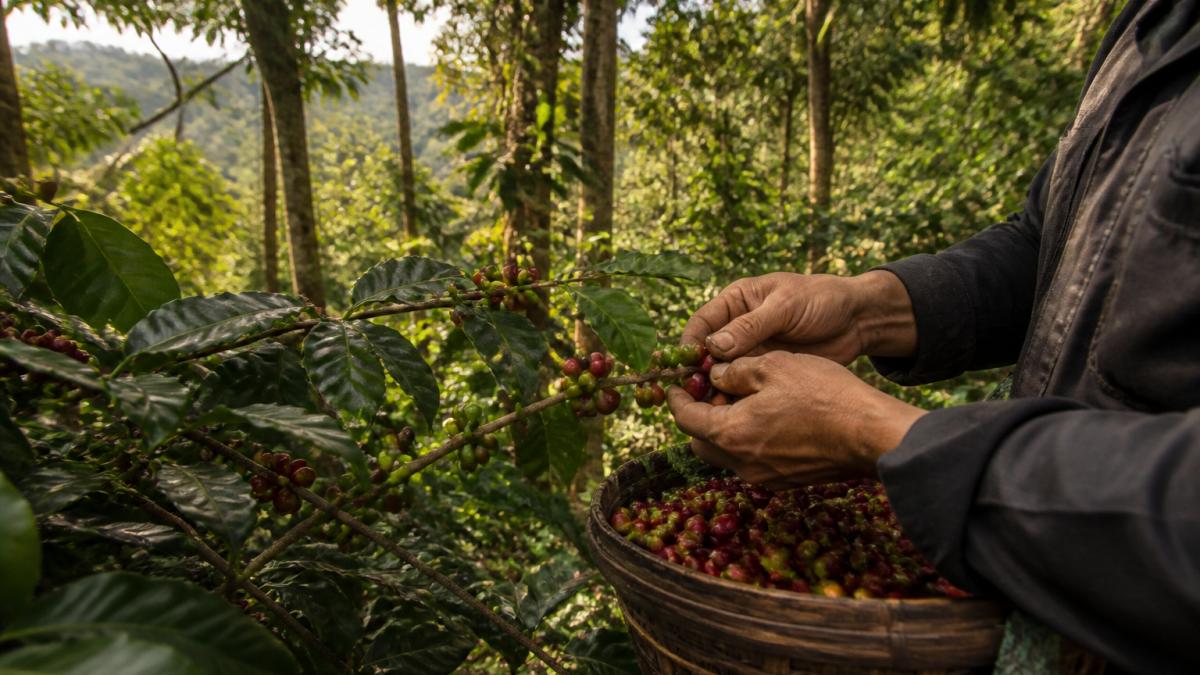
Full-sun plantations maximize yield by removing trees and maximizing inputs. Shade-grown systems use taller trees (often native species) to provide partial shade, reducing yield per acre but creating a forest-like environment.
Shade-grown farms host birds, insects, and small mammals that full-sun plantations cannot support. The tree canopy moderates temperature, reduces evaporation, and adds organic matter to soil.
Agroforestry integrates trees with crops for income diversification. Farmers select shade trees that produce fruit, timber, or nitrogen-fixing legumes. If coffee prices collapse, income from other sources helps sustain the farm.
Coffee Farm Water Conservation and Responsible Water Use
Water is essential and scarce on many coffee farms. Processing coffee requires large volumes of water, often 140 to 190 liters per kilogram of finished beans. Sustainable practices reduce consumption and protect water quality.

On-Farm Water Capture and Storage
On-farm water storage captures rainfall during wet seasons for use during dry periods. Ponds, tanks, or cisterns reduce dependence on groundwater and surface streams. Farms tracking water use often reduce groundwater extraction by 30-50% through storage alone.
Mulching and shade reduce soil evaporation. Drip irrigation delivers water directly to roots, using 20-30% less water than overhead irrigation while improving plant health.
Processing Water: The Larger Challenge
Coffee processing requires large water volumes. Traditional wet processing uses 140-190 liters per kilogram of finished coffee. Untreated wastewater pollutes streams and groundwater.
Sustainable farms choose among three approaches:
Wet processing with wastewater treatment: Farms install settling ponds or constructed wetlands where wastewater sits for 24-48 hours. Solids settle and cleaner water is discharged or reused, protecting watersheds.
Pulped natural (semi-washed) processing: This method removes the outer skin but leaves fruit mucilage on the bean during drying.
Dry (natural) processing: The entire fruit dries on the bean before removal. This uses minimal water but requires reliable dry seasons and produces heavier body and berry notes.
Farms measure water sustainability through metrics: liters per kilogram of finished coffee, percentage of wastewater treated, and groundwater depletion rates. Leading farms track these and set reduction targets.
Regional Water Constraints and Trade-Offs
Water availability varies by altitude, rainfall, and local stress. High-altitude farms with abundant rainfall can use wet processing sustainably. Water-scarce regions may need semi-washed or dry processing. On-farm storage and efficient processing become critical in water-stressed areas.
The most sustainable choice depends on local conditions. Sustainability means matching practices to place.
Sustainable Coffee Certifications: What They Verify and How to Choose
Multiple certification systems exist with different standards and audit rigor. Understanding what each verifies helps you choose coffee aligned with your values.
Major Certification Systems and Their Scope
Fair Trade Certification verifies minimum price floors and labor standards. Audits focus on price transparency, worker wages, child labor prevention, and freedom of association.
Organic Certification confirms that prohibited synthetic pesticides, herbicides, and fertilizers were not used for at least three years.
Rainforest Alliance Certification checks environmental practices (shade cover, water management, soil health), worker welfare, and business viability. Audits occur every three years with unannounced spot-checks.
UTZ Certification focuses on sustainable farming practices and supply chain transparency. Audits verify traceability, pesticide management, and farmer training. UTZ does not require organic practices or minimum prices.
Bird Friendly Certification (offered by the Smithsonian Migratory Bird Center) is the most rigorous on biodiversity.
Verification Rigor and Audit Frequency
Certification strength depends on audit frequency and depth. Annual audits catch more problems than triennial audits. Unannounced inspections are more reliable than scheduled ones. Third-party auditors are more rigorous than first-party audits. Fair Trade and Organic typically conduct more thorough audits than UTZ or Rainforest Alliance.
Combining Certifications: Coverage and Cost
No single certification covers everything. A coffee can be organic but not Fair Trade, or Fair Trade but not organic, or Rainforest Alliance but not organic.
Farms pursuing multiple certifications face cumulative costs. The investment makes sense only if premium prices justify it. Organic + Fair Trade coffee typically commands premium prices above conventional, which covers certification costs and provides real income benefit.
Reading Certification Claims: Red Flags and Verification
Certification labels can be misleading. "Natural," "eco-friendly," "sustainable," or "ethically sourced" claims without a third-party certification logo are marketing language. Always look for the actual certification logo and verify the farm on the certifier's website.
When evaluating coffee, ask roasters: Which certifications does this coffee hold? When was it last audited? Roasters sourcing from specific farms can answer these questions and often conduct more rigorous private audits than certification alone requires.
The Certification Gap: What They Don't Measure
Certifications verify compliance with standards but often miss outcomes that matter. A farm can be certified organic and still have eroding soil, low biodiversity, or farmer poverty if yields are too low. Certifications check inputs and practices, not results. When choosing coffee, look for roasters who share both certification status and farm-level metrics like yield, altitude, and farmer cooperative size. Our Honduras offering, for example, is certified both Organic and Fair Trade, grown at 1,300-1,700 meters by 1,500 cooperative members, specifics that let you understand the farm's scale and conditions beyond the labels alone.

Climate-Smart Agriculture and Regenerative Farming for Coffee Resilience
Climate change threatens coffee production directly. Rising temperatures shift suitable growing zones uphill and poleward. Irregular rainfall creates drought and flood stress. Sustainable farms build resilience through climate-smart practices.
Shade trees moderate temperature extremes and provide income if coffee yields drop due to climate stress. Diverse crops reduce risk, if coffee fails, other sources sustain the farm. Soil organic matter acts as a carbon sink and improves water retention during droughts.
Regenerative practices go further, actively rebuilding soil and ecosystem function. Farmers might introduce perennial cover crops, increase tree density, or rotate coffee with other crops. These practices sequester carbon, improve water infiltration, and build soil resilience.
The Economics of Sustainable Coffee Farming: Costs, Returns, and Farmer Livelihoods
Sustainable practices require upfront investment and often reduce short-term yields. Transitioning from chemical inputs to organic methods typically means lower harvests for 2-3 years while soil rebuilds. Installing water storage, terracing hillsides, and establishing shade trees all cost money.
The payoff arrives over years, not months. Reduced input costs eventually offset lower yields. Premium prices for certified sustainable coffee can exceed conventional prices significantly. Diversified income from shade trees or other crops improves financial stability.
For smallholder farmers, who produce most of the world's coffee, this economics matters intensely. A farmer with limited capital cannot afford to lose income for three years while transitioning.
Putting It All Together: Choosing and Supporting Sustainable Coffee
Understanding these practices helps you choose coffee with confidence. Look for certifications that verify what matters to you. Ask roasters about their sourcing relationships. Support brands that trace coffee back to specific farms and farmers.
| Practice | Primary Benefit | Implementation Difficulty |
|---|---|---|
| Organic (reduced chemicals) | Soil health, ecosystem recovery | Medium (requires transition period) |
| Shade-grown/agroforestry | Biodiversity, income diversification | Medium (requires tree establishment) |
| Water conservation | Reduced waste, watershed protection | Low to medium (varies by method) |
| Soil conservation (terracing, mulch) | Erosion control, long-term productivity | Medium (labor-intensive) |
| Climate-smart practices | Resilience to weather stress | Medium (requires planning) |
When you buy sustainable coffee, you're not just paying for a product. You're supporting farms that protect water and soil, maintain biodiversity, and treat workers fairly. Beans from sustainable farms like those producing our Honduras offering, grown at 1,300-1,700 meters by 1,500 cooperative members, develop richer flavor profiles.
Frequently Asked Questions
What are the main sustainable coffee farming practices?
Sustainable coffee farming practices include organic soil management without synthetic pesticides, shade-grown coffee that preserves tree cover and biodiversity, water conservation techniques, climate-smart agriculture adapted to changing conditions, and agroforestry systems that integrate multiple crops. These practices work together to protect ecosystems, improve farm resilience, and support farmer livelihoods while maintaining coffee quality and yield.
How does shade-grown coffee support biodiversity?
Shade-grown coffee maintains a canopy of native trees above the coffee plants, creating habitat for birds, insects, and other wildlife. This tree cover preserves ecosystem services, reduces erosion, improves soil health, and regulates water cycles. Unlike full-sun coffee plantations that require clearing forests, shade-grown systems integrate coffee into existing forest ecosystems, protecting wildlife habitat while producing coffee.
What do sustainable coffee certifications actually verify?
Sustainable coffee certifications verify specific environmental, social, and economic standards. Organic certifications confirm the absence of synthetic pesticides and fertilizers. Fair Trade certifications ensure farmer payments and community investments. Rainforest Alliance certifications assess biodiversity protection, water use, and worker welfare. When choosing certified coffee, check the certification label on packaging to understand which standards apply to that specific product.
How can coffee farmers conserve water while maintaining crop yield?
Coffee farmers conserve water through mulching to reduce evaporation, improving soil structure to increase water retention, implementing drip irrigation systems that target plant roots, and managing shade trees that reduce temperature and water loss. Composting and organic matter addition enhance soil water-holding capacity. These practices maintain or improve yields while reducing water consumption, critical as climate change increases drought risk in coffee-growing regions.
Is sustainable coffee farming more expensive for consumers?
Sustainable and organic coffee typically costs more than conventional coffee because sustainable practices require more labor, careful management, and certification. However, the premium reflects genuine environmental protection, farmer compensation, and often superior quality. Many consumers find the investment worthwhile for fresher, higher-quality beans and the assurance that their purchase supports responsible farming and farmer livelihoods.
What's the difference between organic and sustainable coffee?
Organic coffee focuses specifically on eliminating synthetic pesticides and fertilizers through certified farming methods. Sustainable coffee is broader, encompassing organic practices plus environmental conservation (biodiversity, water, soil), social equity (farmer welfare, community investment), and economic viability. All organic coffee can be sustainable, but sustainable coffee may include some conventional practices if they meet broader environmental and social standards.
Choosing sustainable coffee means understanding where it comes from and how it was grown. The practices that protect soil, water, and biodiversity also create better-tasting coffee. At Smokin Java, we partner directly with farms practicing shade-grown cultivation, water conservation, and soil restoration. Our Mexico and Peru single-origins are roasted the day they ship, delivering the freshest expression of those sustainable practices to your cup.