

Table of Contents
- Start With the Flavor You Already Love
- Coffee Flavor Profiles by Region: A Practical Map
- Why Altitude Changes What You Taste in Coffee by Region
- How Processing Methods Shape Regional Flavor
- How to Brew Single Origin Coffee Without Wrecking Its Character
- The Best Coffee Roast for Beginners (and When to Go Darker)
- Match Your Region to Your Brewing Method
- Sustainability and Freshness Signals Worth Checking
- Frequently Asked Questions
Last Updated: September 30, 2026
Start With the Flavor You Already Love
Choosing coffee by region gets much easier once you stop chasing unfamiliar labels and start from the cup you already enjoy. If your daily pour-over tastes like cocoa and caramel, you're probably a Latin America person. If you crave something brighter and fruitier, Africa is calling.
At Smokin Java, we roast every batch upon order, which means the regional character of a bean actually survives the trip to your kitchen. That matters more than most buying guides admit, because origin is the single biggest lever on flavor before roasting even begins.
Below, we'll show you exactly how to read a region like a flavor label, and how to match it to your brewer without guesswork.
Coffee Flavor Profiles by Region: A Practical Map
Coffee flavor profiles by region fall into three broad families: Latin American coffees lean sweet and balanced, African coffees run bright and fruity, and Asia-Pacific coffees land earthy and heavy. Learning those three buckets covers most of what you'll ever see on a bag.
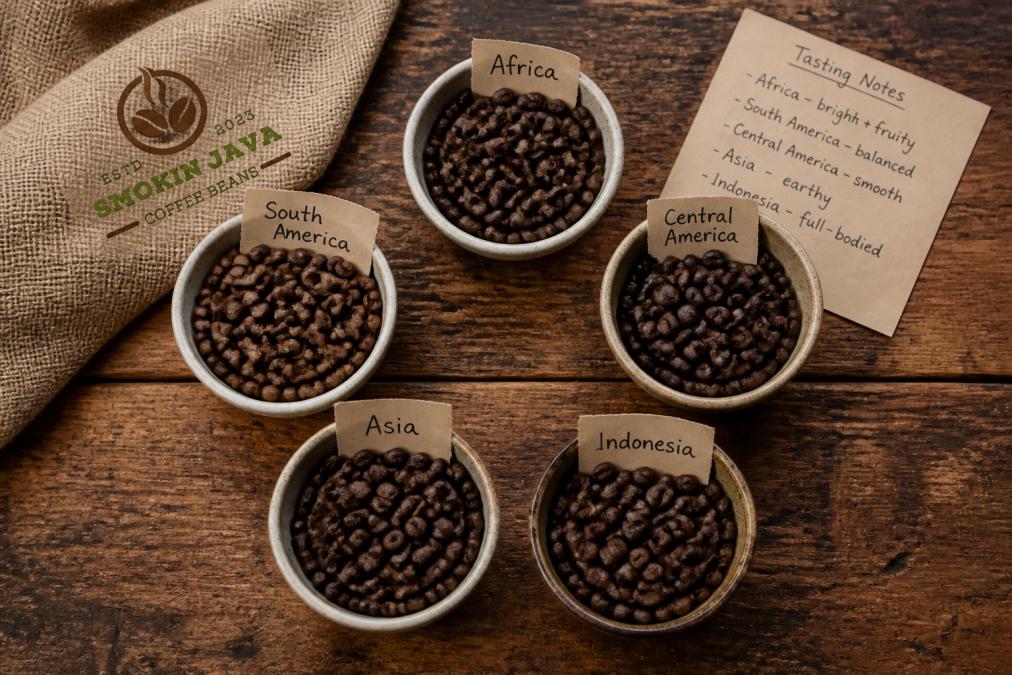
Latin America: Cocoa, Caramel, and Citrus
Latin American beans are the crowd-pleasers. A medium roast from this region typically delivers cocoa, caramel, and a soft citrus edge, with medium acidity and a rounded body.
Our Colombia, for instance, carries dried orange, berry, and chocolate notes from smallholder farmers from Medellin, grown between 1,300 and 1,500 meters. Brazil Santos runs smoother still: elegant, cocoa-forward, and grown lower at 750 to 1,050 meters. If you're new to single origin, start here. Consider our Single Origin Favorites Sample Pack to explore these and other distinct profiles.

Africa: Berries, Florals, and Bright Acidity
African coffees are the ones that make people fall in love with black coffee. Expect berry, floral, and citrus notes with high acidity and a lighter body.
Ethiopian beans from the Sidama zone, grown at 1,700 to 1,900 meters, show milk chocolate, fruit, and caramel. That combination of altitude and heirloom varietals is why African coffees taste so vivid. You can find this profile in our Single Origin Favorites Sample Pack.
Asia-Pacific: Earthy, Syrupy, and Full-Bodied
Asia-Pacific coffees trade brightness for weight. Think dark chocolate, molasses, and brown sugar, with low acidity and a syrupy mouthfeel.
Bali Blue is the textbook example: organic, wet-hulled, and grown between 1,200 and 1,600 meters in Kintamani. It's the region to reach for when you want a cup that stands up to milk or a dark roast habit. Explore our Bali Blue for this unique experience.
Why Altitude Changes What You Taste in Coffee by Region
Altitude is the quiet variable behind almost every regional flavor difference. Higher-grown beans develop more slowly, pack in more density, and hold more concentrated sugars and acids. That's why a 1,800-meter Ethiopian bean tastes brighter than a 900-meter Brazilian one.
The practical takeaway: when you compare coffee by region, check the altitude on the label. Anything above 1,500 meters usually signals a more complex, acidic cup. Below 1,200 meters, expect softer, sweeter, heavier flavors.
How Processing Methods Shape Regional Flavor
Processing method is the second half of the flavor equation, and it's the part most guides skip. Washed process coffees taste clean and let the region's acidity lead. Natural process coffees taste fruitier and heavier, because the fruit dries onto the bean. Honey and pulped natural sit in between, adding sweetness without full fruit intensity. A common mistake is assuming a region always tastes one way; the same Ethiopian bean can taste like blueberries when natural-processed and like black tea when washed.
What most buying guides leave out is that processing is not evenly distributed across regions. Each origin has a dominant method shaped by water access, labor, and tradition, and that method is often the real reason a region tastes the way it does.
- Latin America, washed dominant. Colombia, Guatemala, Costa Rica, and Honduras overwhelmingly use washed processing. Water is plentiful in the mountain valleys, and washed coffee gives the clean, balanced cocoa-citrus profile buyers expect. Costa Rica also runs a large honey-process program; a Costa Rican honey process will taste noticeably sweeter and rounder than its washed sibling from the same farm.
- Africa, washed with a natural undercurrent. Ethiopia and Kenya are primarily washed, which is why their cups read as tea-like and floral. Ethiopia also produces a significant volume of natural-processed coffee, especially from Sidama and Yirgacheffe, and those lots are the blueberry-bomb coffees people associate with the region. If you want the fruit-forward version, look for "natural" on the bag; if you want the tea-like version, look for "washed."
- Asia-Pacific, wet-hulled (giling basah). Indonesia, and Bali in particular, uses wet-hulling, a method where the parchment is removed while the bean is still swollen with moisture. That step is the direct cause of the region's signature earthy, syrupy, low-acid cup. A washed Indonesian coffee tastes dramatically cleaner and brighter than a wet-hulled one, which is a useful comparison if you want to isolate how much of the flavor comes from the region versus the process.
- Brazil, pulped natural and natural. Brazil is the outlier in Latin America. Its dry climate and large estates favor natural and pulped natural processing, which is why Brazilian coffees taste nuttier and sweeter than their washed Colombian neighbors even at similar altitudes.
Here is the practical rule: when you read a bag, treat processing as a modifier on top of the region, not a substitute for it.
How to Brew Single Origin Coffee Without Wrecking Its Character
Learning how to brew single origin coffee is mostly about restraint. These beans have distinct flavors, and heavy-handed brewing flattens them.
A few rules that hold up in practice:
- Grind medium for drip, medium-fine for pour-over, coarse for French press
- Keep water between 195°F and 205°F
- Use a 1:15 to 1:16 coffee-to-water ratio by weight
- Skip dark, oily roasts in delicate brewers; they clog filters and taste muddy
The Best Coffee Roast for Beginners (and When to Go Darker)
The best coffee roast for beginners is a medium roast, full stop. Medium roasting preserves origin character while keeping acidity and bitterness in balance, so you can actually taste what makes each region different.
Match Your Region to Your Brewing Method
Brewing method compatibility by region is the angle most buying guides ignore, and it changes your purchase decision more than roast date alone.
| Region | Flavor Lean | Best Brewing Method |
|---|---|---|
| Latin America | Cocoa, caramel, citrus | Drip, espresso, moka pot |
| Africa | Berry, floral, bright | Pour-over, Chemex, AeroPress |
| Asia-Pacific | Earthy, syrupy, heavy | French press, cold brew, espresso |
Sustainability and Freshness Signals Worth Checking
Sustainability claims are everywhere, so look for specifics rather than slogans. Certifications like USDA Organic are verifiable; vague "eco-friendly" language is not. The USDA Organic certification program sets the actual standards behind that label. Fair trade certification is a separate, verifiable signal that addresses pricing and labor conditions rather than farming inputs, so a bag can carry one, both, or neither.
- Washed African coffees lose their floral and berry aromatics faster than any other category. Their delicate volatile compounds oxidize quickly, so buy smaller bags and finish them within three to four weeks of the roast date. If you buy a 2-pound bag of a washed Ethiopian and take two months to drink it, the last third will taste like a different, flatter coffee.
- Wet-hulled Asia-Pacific coffees are the most forgiving. Their earthy, syrupy profile is built on heavier compounds that hold up longer, and many drinkers find they peak two to three weeks after roast rather than one. A Bali Blue stored properly can still taste correct at six weeks.
- Natural-processed coffees sit in the middle but trend toward the African pattern. The fruit-forward notes are volatile, so treat them like the delicate category even if the bean is from Brazil.
- Dark roasts degas faster and stale faster than light roasts regardless of origin, because the roasting process has already driven off many of the aromatic compounds. If you buy dark, buy smaller.
Frequently Asked Questions
What are the flavor profiles of coffee by region?
Latin American coffees typically show cocoa, caramel, and citrus with balanced acidity. African beans bring berry, floral, and tea-like notes with brighter acidity. Asia-Pacific origins lean earthy, syrupy, and full-bodied with dark chocolate and molasses. Altitude, soil, varietal, and processing method all shift these baselines, so treat regional profiles as starting points rather than fixed rules when you choose coffee by region.

How does altitude affect the taste of coffee beans?
Higher altitudes slow cherry maturation, which builds bean density and concentrates sugars and acids. Coffees grown above roughly 1,300 meters often taste brighter, sweeter, and more complex. Lower-grown beans like Brazil Santos at 750-1050 meters tend to be smoother and nuttier with lower acidity. This is why altitude is one of the most reliable markers when comparing coffee by region.
Is there a difference between African and Latin American coffee beans?
Yes, and it shows up in the cup. African coffees, especially Ethiopian naturals, often deliver fruity, floral, and wine-like notes with lively acidity. Latin American washed coffees lean toward chocolate, caramel, and mild citrus with a rounder body. Neither is better; the choice comes down to whether you want brightness or balance in your daily brew.
How do I brew single origin coffee so the regional flavor actually comes through?
Use a 1:15 to 1:16 coffee-to-water ratio, water between 195 and 205 degrees Fahrenheit, and a medium grind for drip or pour-over. Lighter African roasts reward slightly hotter water and a finer grind; darker Asia-Pacific beans do better a touch cooler. Weigh your beans, keep the brew time consistent, and adjust one variable at a time.